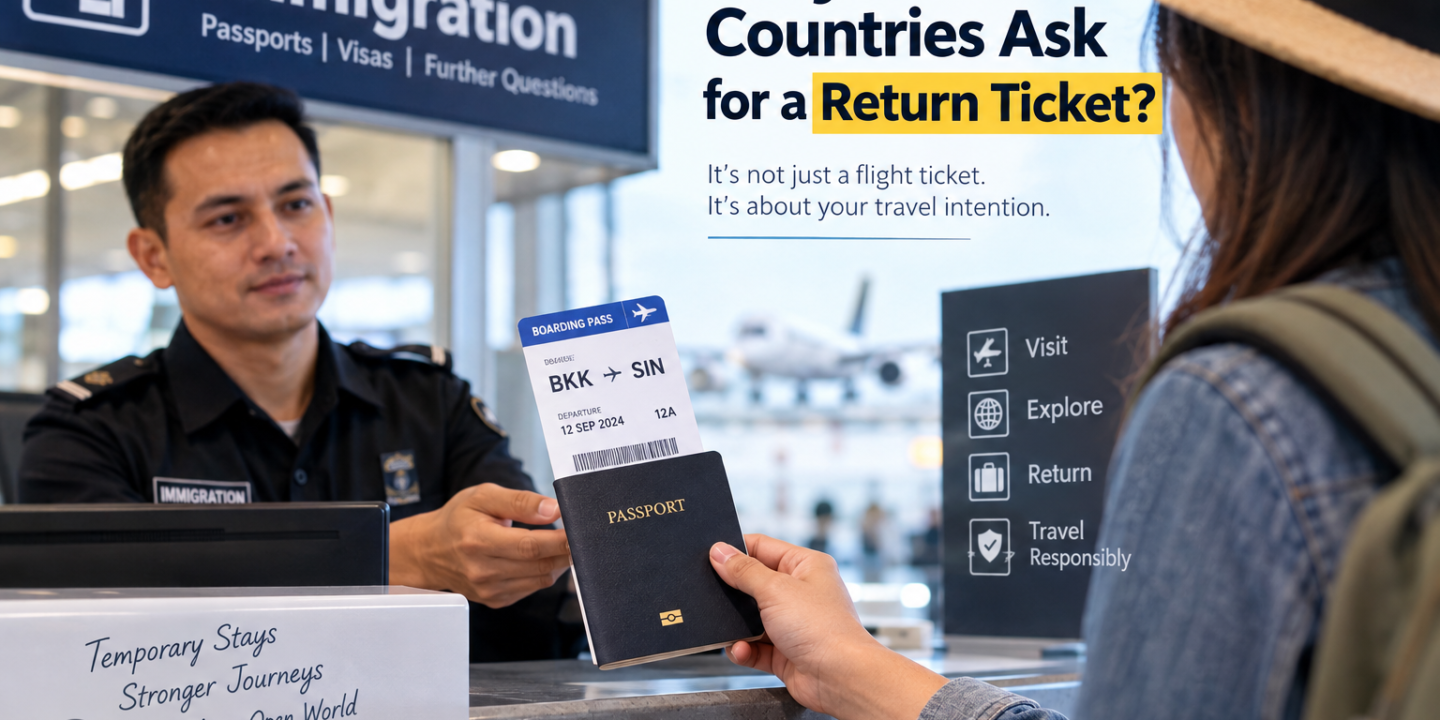


If you have travelled internationally, you may have encountered a surprisingly simple question at the airport:
“Do you have a return ticket?”
Sometimes the question comes from an airline employee before you board. Sometimes an immigration officer asks about your plans at the destination. In some countries, you may even need to show a confirmed ticket leaving the country before you can enter.
This often feels confusing. After all, if you have a valid passport, visa or visa-free entry permission, hotel booking, and enough money for your trip, why should immigration care about another flight?
The answer has less to do with the airline ticket itself and more to do with whether you appear to be entering temporarily and whether you have a realistic plan to leave.
That is the central reason why countries ask for a return ticket or other proof of onward travel.
However, there is an important distinction. Not every country requires a return ticket from every traveller. Requirements can depend on your nationality, visa type, purpose of travel, length of stay and destination. Some countries specifically require a confirmed onward ticket, while others focus more broadly on whether you can demonstrate that you will leave when your permitted stay ends.
For example, Thailand’s current visa-exemption guidance says eligible travellers may need to present proof of onward travel scheduled within the permitted period, while Indonesia’s immigration authorities explicitly list a return or onward ticket among requirements for certain foreign visitors.
So, why do countries ask for return tickets?
The real reason is border management. Governments want evidence that visitors understand the temporary nature of their permission to stay and have a credible way to leave the country.
Let’s look at how the system actually works.
Table of Contents
Why Do Countries Ask for Return Ticket?
The simplest explanation is that a return or onward ticket gives immigration authorities evidence of your intended departure.
When a country allows you to enter as a tourist, visitor or other temporary traveller, it is granting you permission to stay under specific conditions. That permission does not normally mean you can remain indefinitely.
A return ticket provides one piece of evidence that your trip has a defined endpoint.
But immigration authorities generally look at more than the ticket.
They may consider:
- Your passport and nationality
- Your visa or visa-free status
- Your stated purpose of travel
- How long you intend to stay
- Your accommodation
- Your financial resources
- Your previous international travel
- Your onward or return arrangements
- Your answers to questions at the border
- Whether your circumstances are consistent with the type of entry permission you are using
Canada, for example, states that visitors must convince an officer that they will leave Canada at the end of their authorized stay and that they have enough money for their visit. The Canadian government also considers ties such as employment, home, financial assets or family when assessing temporary visitors.
This illustrates an important point:
A return ticket is evidence, not a guarantee of entry.
A Return Ticket Is Really About Temporary Intent
The deeper issue behind the return-ticket question is often called temporary intent.
Imagine two travellers arriving at the same airport.
Traveller A says:
“I’m visiting for 10 days. I have a hotel booking, enough money for the trip, and I’m flying home on the 10th day.”
Traveller B says:
“I’m not sure how long I’ll stay. I have no onward ticket and I’ll decide what to do after I arrive.”
Those situations can create very different impressions.
The first traveller has a clearly defined temporary trip.
The second traveller may still be a genuine tourist, but the immigration officer has fewer documents supporting that explanation.
That does not automatically mean Traveller B will be refused. It simply means the officer may ask additional questions.
A return or onward ticket helps reduce that uncertainty.
What Is Proof of Onward Travel?
Proof of onward travel means evidence that you have arrangements to leave the country you are entering.
It does not always have to mean a flight back to your home country.
For example, imagine you are travelling from India to Thailand and then continuing to Malaysia.
Your travel plan could be:
India → Thailand → Malaysia → India
In that situation, a ticket from Thailand to Malaysia may serve as proof of onward travel.
This is why immigration rules often use terms such as “return or onward ticket” rather than simply “return ticket.”
Indonesia, for example, refers to a return ticket or a ticket continuing to another country in its entry requirements for certain foreign visitors.
The key question is usually not:
“Are you flying home?”
It is:
“Do you have a credible plan to leave this country?”
Why Governments Care About Your Departure Plans
There are several reasons governments pay attention to onward travel.
1. To Enforce Immigration Time Limits
Most temporary visitors receive permission to stay for a specific period.
That might be a few weeks, a few months or another period defined by the country’s immigration rules.
A return or onward ticket can help demonstrate that your planned trip fits within that period.
For example, if your permitted stay is limited and your onward flight is scheduled before that deadline, the itinerary supports your stated travel plan.
However, travellers should understand that having a ticket does not give you permission to stay until the ticket date.
The immigration authority determines how long you may legally remain.
Canada makes this distinction clear. A border officer can determine the authorized period of stay, and visitors must leave by the applicable deadline.
2. To Reduce the Risk of Overstaying
Overstaying a visa or permitted stay can create immigration problems.
Depending on the country and circumstances, an overstay may lead to penalties, immigration records, future visa difficulties or other consequences.
Governments therefore have an interest in identifying travellers who appear likely to remain beyond their authorized period.
A return or onward ticket does not eliminate that risk, but it provides additional evidence about the traveller’s plans.
3. To Distinguish Tourism From Other Purposes
A person may enter a country under a tourist or visitor category even though they actually intend to work, study or remain for a much longer period.
Immigration systems are designed to distinguish between different purposes of travel.
For example, Australia states that visitors must hold the appropriate visa and that visa conditions determine what activities they can undertake.
A traveller who says they are visiting for tourism but has no clear departure plan may therefore face more questions about what they actually intend to do.
4. To Manage People Who May Become Inadmissible
Countries also have to consider what happens if a visitor cannot remain legally.
If authorities refuse entry, the traveller may need to return to the place they came from or continue to another country where they are permitted to enter.
This is one reason governments and airlines pay close attention to travel-document compliance.
IATA explains that airlines perform document checks because passengers who do not meet destination requirements can create operational, financial and legal problems for carriers.
Is the Airline or Immigration Asking for Your Return Ticket?
This is one of the most important distinctions travellers need to understand.
The airline and immigration authorities are not the same thing.
An airline may check your documents before allowing you to board.
Immigration officers make decisions about entry when you reach the border.
The Airline’s Role
Before an international flight, the airline needs to establish whether you appear to have the documents required for your journey.
This can include:
- Passport validity
- Visa requirements
- Transit requirements
- Entry permits
- Health documentation where applicable
- Return or onward travel requirements
IATA says its Travel Centre provides passport, visa and health requirement information based on data from official sources worldwide, and its travel-document systems are used by airlines to assess passenger requirements.
Why does the airline care?
Because carrying a passenger who cannot legally enter the destination can create significant problems for the airline.
IATA has noted that airlines can face fines and removal-related costs when passengers arrive without the documents required for entry.
That is why an airline employee may ask about your return ticket even before you leave your home country.
The Immigration Officer’s Role
Immigration officers work at the border.
They assess whether you meet the country’s entry requirements.
Even if the airline allowed you to board, immigration can still ask questions when you arrive.
Likewise, having a return ticket does not automatically guarantee entry.
IATA specifically warns travellers that possessing the correct documents does not guarantee admission because the final decision rests with the relevant immigration authorities.
This distinction is crucial.
Airline approval to board is not the same as immigration approval to enter.
Can Immigration Turn You Away Without a Return Ticket?
Yes, in countries or circumstances where proof of onward travel is an entry requirement, the absence of that proof can create a problem and may contribute to refusal of entry.
But there is no universal rule saying that every traveller without a return ticket will be refused.
The actual answer depends on the destination’s rules and your circumstances.
For example, UK government travel guidance for Nicaragua says travellers may be refused entry if they do not have an onward ticket.
Guidance for Cyprus states that travellers may be asked to show a return or onward ticket and demonstrate sufficient funds.
Ecuador’s immigration guidance similarly says travellers may be asked to provide evidence of a return or onward flight or bus ticket showing when they will leave the country.
These examples demonstrate why travellers should not rely on a general statement such as:
“Immigration never asks for return tickets.”
The rules vary considerably.
What Happens If You Have a One-Way Ticket?
A one-way flight is not automatically a problem.
People travel internationally on one-way tickets for many legitimate reasons.
For example:
- Students may travel for a long-term course.
- Workers may relocate under an appropriate visa.
- Digital nomads may have specific immigration permission.
- Travellers may have an itinerary involving several countries.
- People may continue by land instead of air.
- Permanent residents may not need a return ticket.
- Citizens returning to their own country generally do not need to prove that they will leave.
The problem arises when the destination’s rules require proof of onward travel or when your travel circumstances do not support the immigration status you are using.
For example, Indonesia’s immigration authority states that certain foreign visitors entering under visa-exempt arrangements must have a return or onward ticket.
Therefore, one-way flight immigration rules depend heavily on your immigration category.
Why a Return Ticket Can Strengthen Your Case
A return ticket can answer several basic questions at once.
Where are you going?
Your itinerary establishes your destination.
How long are you staying?
Your departure date provides an approximate length of stay.
Do you have an exit plan?
The ticket shows that you have arranged transportation out of the country.
Does your itinerary fit your visa?
If you hold a short-term visitor permission but your travel plans suggest a much longer stay, authorities may ask questions.
The ticket can therefore form part of a larger story about your trip.
However, it should match the rest of your documentation.
If your hotel booking says you are staying for 10 days but your onward flight leaves 45 days later, an officer may reasonably ask why.
What Counts as Proof of Onward Travel?
The exact acceptable evidence varies by country.
Common forms include:
- A confirmed return flight
- A confirmed flight to another country
- A confirmed bus ticket
- A confirmed train ticket
- A cruise itinerary
- Another documented form of onward transportation
Some countries may require a specific type of ticket, while others use broader language.
For example, Ecuador’s guidance refers to a return or onward flight/bus ticket.
This means travellers should not automatically assume that a flight is the only acceptable form of onward travel.
If you plan to cross a land border, check the destination’s specific rules before travelling.
Bestseller #1
Bestseller #2

Bestseller #3
Does a Refundable Ticket Count?
A refundable ticket may satisfy a requirement in some circumstances, but travellers should not assume that every destination or airline will accept every type of reservation.
The important question is what the relevant authority considers valid proof.
A confirmed booking, reservation, ticket and proof of payment can have different meanings depending on the rule.
Also, purchasing a ticket purely to pass a document check and immediately cancelling it can create practical and ethical complications.
IATA has pointed out that some governments require onward tickets even though tickets can later be cancelled, which illustrates why the presence of a ticket does not always provide a perfect picture of a traveller’s actual intentions.
The safest approach is to follow the destination’s published requirement rather than relying on online travel hacks.
What If You Don’t Know Your Return Date?
This is a common problem for long-term travellers.
You may want flexibility because you do not know exactly when you will leave.
In that situation, your first step should be to determine whether your destination actually requires proof of onward travel.
If it does, consider whether the rules allow an onward ticket rather than a ticket back home.
For example, if you are travelling through Southeast Asia, your next destination may be more relevant than your eventual flight back to India.
You should also check whether the destination accepts other forms of evidence.
Do not assume that a flexible travel plan automatically gives you an exemption from an onward-ticket requirement.
Does a Visa Guarantee That You Can Enter Without a Return Ticket?
No.
A visa is important, but it does not necessarily eliminate border-entry requirements.
Countries can impose conditions at the border even when a traveller holds a valid visa.
Canada, for example, states that holding the necessary travel documents does not by itself guarantee admission. Border officers still determine whether the traveller meets the applicable entry requirements.
Similarly, Australia explains that travellers need the appropriate visa for their circumstances, but the visa itself does not automatically authorize every activity or guarantee entry under every circumstance.
So if your visa says you can visit for tourism, that does not mean you can ignore the destination’s other entry conditions.
Why Some Countries Are Strict About Onward Tickets
Different countries have different immigration priorities.
Some destinations experience large numbers of short-term international visitors. Others have specific visa-exemption systems that allow travellers to enter without applying for a traditional visa before departure.
In those situations, governments may use requirements such as onward travel, accommodation and proof of funds as part of their border controls.
Thailand is a useful example.
Its current guidance says immigration officers may request proof of accommodation, proof of onward travel and evidence of sufficient funds from eligible foreign visitors.
Indonesia also explicitly includes return or onward travel documentation in several visitor entry categories.
These requirements do not mean every traveller will receive exactly the same questioning.
Border officers can assess individual circumstances.
Return Ticket vs Onward Ticket: What’s the Difference?
The terms sound similar, but there is a useful distinction.
Return ticket
A return ticket generally means you travel back to the country where your trip began or another relevant home destination.
Example:
Delhi → Bangkok → Delhi
Your Bangkok-to-Delhi flight is your return ticket.
Onward ticket
An onward ticket means you leave the destination and continue somewhere else.
Example:
Delhi → Bangkok → Kuala Lumpur
Your Bangkok-to-Kuala Lumpur flight is your onward ticket.
For immigration purposes, the second arrangement can be perfectly relevant where the rules accept onward travel.
That is why travellers should always look for the exact wording in the official requirements.
What Immigration Is Really Trying to Establish
A return ticket is only one part of a bigger assessment.
An immigration officer may essentially be trying to establish four things:
1. Who are you?
Your passport and identity documents answer this question.
2. Why are you coming?
Your stated purpose should match your visa or entry category.
3. How will you support yourself?
You may need to demonstrate that you have sufficient money for your stay.
4. What happens when your permitted stay ends?
Your return or onward arrangements can help answer this question.
Australia, for example, asks temporary visa applicants to demonstrate that they intend to return to their home country or usual country of residence, with supporting evidence potentially including employment, study or family connections.
This shows why immigration is rarely interested in the flight ticket alone.
The ticket forms part of a broader assessment of your travel circumstances.
What If Your Return Ticket Is After Your Visa Expires?
This can raise questions.
Suppose your visitor permission allows you to remain for 30 days, but your return ticket is booked for 45 days after arrival.
An officer may want to know why.
The ticket does not extend your legal stay.
You must comply with the immigration permission granted to you, regardless of the date printed on your flight reservation.
If you need to remain longer, you must follow the destination’s legal process for extending or changing your status.
Do not assume that changing your flight is enough.
What Documents Should You Carry?
For international travel, keeping your documents organized can make border checks much easier.
Depending on your destination and immigration status, consider carrying:
- Passport
- Visa or electronic travel authorization
- Return or onward ticket
- Hotel or accommodation confirmation
- Travel insurance, where relevant
- Proof of sufficient funds
- Invitation letter, where applicable
- Employment or student documentation, where relevant
- Details of your travel itinerary
- Documents supporting the purpose of your visit
You do not necessarily need to show every document.
The point is to have the relevant evidence available if an airline or immigration officer asks for it.
Don’t Rely on Social Media Travel Hacks
One of the biggest mistakes travellers make is treating immigration requirements like universal travel rules.
You may see someone online saying:
“I entered without a return ticket, so you don’t need one.”
That experience may be genuine.
It still does not establish the rule for everyone.
Immigration requirements can depend on:
- Passport nationality
- Destination
- Visa category
- Purpose of travel
- Length of stay
- Transit arrangements
- Previous immigration history
- Current government policy
IATA specifically notes that travel requirements can change frequently and recommends checking current, personalized information close to departure.
That is much safer than relying on a traveller’s experience from another country or another year.
How to Check Whether You Need a Return Ticket
Before booking your flight, follow a simple process.
Step 1: Check the destination’s official immigration website
Look for sections titled:
- Entry requirements
- Visa requirements
- Visitor requirements
- Immigration requirements
- Visa exemption
- Border requirements
Government sources should be your first reference.
Step 2: Check requirements for your passport
Do not search only for the destination.
Search for requirements that apply specifically to your nationality.
Two travellers arriving on the same flight can have different requirements because they hold different passports.
Step 3: Check your visa category
A tourist, student, worker and transit passenger may face different requirements.
Never assume that a rule applying to tourists applies to every traveller.
Step 4: Check the airline before departure
Airlines may perform their own document checks before boarding.
IATA’s Travel Centre is another useful source for checking passport, visa and health requirements, although travellers should still verify important requirements with the relevant government authority.
Step 5: Check again shortly before travelling
Immigration policies can change.
IATA advises travellers to re-check requirements close to departure because rules and regulations can change frequently.
This is particularly important when travelling several weeks or months after purchasing a ticket.
What Should You Say If Immigration Asks About Your Return Ticket?
The best approach is simple:
Answer truthfully and clearly.
If you have a return ticket, show it.
If you have an onward ticket, explain your itinerary.
If you have no ticket because you are travelling under a visa category that does not require one, explain your situation and provide supporting documentation if requested.
Avoid giving complicated explanations that do not match your documents.
For example:
“I’m visiting Thailand for 10 days. I’m staying at this hotel and then travelling to Malaysia. Here is my onward flight.”
That is much clearer than giving a vague answer about possibly staying longer.
What If You Are Travelling on a One-Way Ticket for a Legitimate Reason?
If your trip genuinely requires a one-way ticket, the most important thing is to make sure your immigration status supports your travel plans.
For example, someone moving under a valid long-term visa may have very different requirements from a tourist entering under a short visa-exemption arrangement.
You should carry evidence supporting the purpose of your journey.
For a student, that might include admission documentation.
For a worker, it could include an employment or work authorization document.
For a resident returning to their country of residence, their residence permit may be more relevant than a tourist return ticket.
The correct document depends on the immigration category.
Is a Return Ticket Proof That You Will Actually Leave?
Not necessarily.
A ticket demonstrates an arrangement.
It does not prove what someone will ultimately do.
A traveller can cancel or change a flight.
This is one reason immigration authorities do not normally treat a return ticket as the only factor in deciding whether someone should enter.
IATA has acknowledged this limitation in discussing government requirements for return or onward tickets.
The broader assessment matters.
A traveller with a return ticket but no credible explanation for their visit could still face questions.
Conversely, a traveller without a return ticket may have a legitimate reason and appropriate immigration status.
The Bigger Picture: Immigration Is Managing Risk
The return-ticket requirement makes more sense when you look at the wider border-control system.
Governments need to balance relatively easy international travel with immigration enforcement.
They need to determine:
- Who is arriving?
- What is the purpose of the visit?
- How long can the person stay?
- Can the person support themselves?
- Are they eligible to enter?
- Are they likely to comply with the conditions of their stay?
- If they must leave, do they have a realistic way to do so?
A return or onward ticket can help answer the final question.
That is why the document has become such a common feature of international travel.
It is not really about the piece of paper or the booking confirmation.
It is about demonstrating a credible exit plan.
Common Questions About Return Ticket Requirements:
Can immigration refuse me just because I have a one-way ticket?
It depends on the country’s rules and your immigration status.
If proof of onward travel is mandatory for your category, not having it can create a serious problem. If it is not mandatory, the officer may instead assess your overall circumstances.
Does every country require a return ticket?
No.
Return-ticket and onward-travel requirements vary by country, nationality and immigration category.
Some governments explicitly require them for particular visitors, while others focus on whether the traveller can demonstrate that they will leave when required.
Is an onward ticket the same as a return ticket?
Not exactly.
A return ticket takes you back, while an onward ticket takes you from the destination to another country.
Many immigration systems accept onward travel rather than requiring you to return directly home.
Can I enter a country without a return ticket?
Sometimes.
It depends on the country’s rules, your nationality, visa and purpose of travel.
Never assume that another traveller’s experience applies to you.
Does having a return ticket guarantee entry?
No.
A return ticket is only one part of your travel documentation.
Immigration officers can consider your visa, purpose of travel, funds, accommodation, travel history and other circumstances.
Can an airline ask for my return ticket?
Yes.
Airlines may check whether passengers appear to meet the destination’s entry requirements before boarding. IATA explains that airlines face significant consequences when passengers arrive without required travel documentation.
What if I plan to travel overland?
You may be able to use evidence of onward bus, train or other transportation if the destination accepts it.
Ecuador, for example, refers to evidence of a return or onward flight or bus ticket in its immigration guidance.
Should I book a return ticket before applying for a visa?
That depends on the visa application instructions.
Some applications ask for an itinerary or evidence of planned travel, while others may not require a purchased ticket at the application stage.
Follow the specific instructions of the destination’s immigration authority rather than buying an expensive non-refundable ticket simply because you assume it is required.
Conclusion:
So, why do countries ask for return ticket?
The real reason is not simply that governments want to know when you are flying home.
A return or onward ticket can provide evidence that a traveller has a defined plan to leave the country and intends to respect the conditions of temporary entry.
It can help airlines assess whether a passenger has the documents needed for the journey. It can also help immigration officers understand the traveller’s itinerary when assessing entry at the border.
But the ticket is only one piece of the puzzle.
A traveller’s visa status, purpose of travel, financial resources, accommodation, travel plans and ability to comply with the permitted stay can all matter.
The most important lesson for international travellers is therefore simple:
Do not treat a return ticket as a universal immigration requirement, but do not assume you can travel without one either.
Before leaving, check the rules that apply specifically to your passport, destination and immigration category.
For current requirements, IATA’s Travel Centre can provide a useful starting point, while the destination country’s official immigration or government website should remain the final authority.
A few minutes spent checking the rules before departure can prevent a much bigger problem at the check-in counter or immigration desk.