
Most of us book flights the same way. You open a booking site, tick “Round trip,” enter your dates, and hit search. It feels quick and sensible.
On budget airlines, though, that habit often costs you money, flexibility, or both.
Low-cost carriers build their prices around single flights, not trips. Once you see that, the round-trip box starts to look less like a shortcut and more like a blindfold. This guide explains how budget airline pricing works, when cheap one-way flights beat a round trip, how split ticketing fits in, and which risks you need to manage.
The Short Answer: Budget Airlines Price Every Flight Separately
Traditional full-service airlines grew up with complicated fare rules. For decades, a return ticket on a legacy carrier often cost less than two one-ways. Sometimes it cost less than a single one-way. Airlines used tricks like the “Saturday night stay” rule to separate business travelers from holidaymakers.
Budget carriers threw that model out.
Airlines like Ryanair, easyJet, Wizz Air, Southwest, Frontier, Allegiant, Jetstar, AirAsia, IndiGo, and Akasa Air sell each flight as its own product. Your outbound seat and your return seat each carry their own price, set by demand on that specific flight. When you book both together, the airline usually just adds the two numbers.
So a round-trip search on a budget airline rarely unlocks a discount. What it does do is lock you into a narrow set of options and hide better ones.
Cheap One-Way vs Round Trip Flights: How the Math Works
Let’s walk through a simple, illustrative example. Say you want a weekend in Barcelona from London.
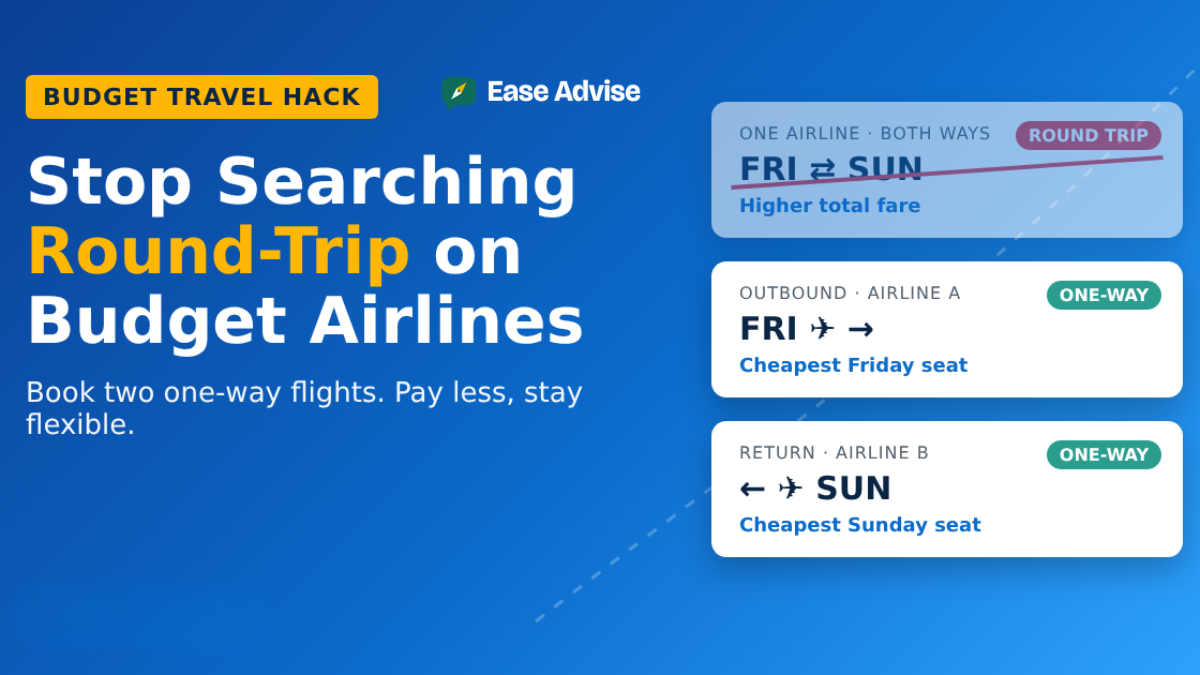
A round-trip search on one airline shows you a Friday evening departure and a Sunday evening return for a combined fare. The total looks fine, so you book it.
Now run the same trip as two one-way searches:
- Friday outbound: Airline A has the cheapest Friday evening seat.
- Sunday return: Airline B has a Sunday afternoon flight that costs far less than Airline A’s return.
Book those two separately and you often pay less than the single-airline round trip. You haven’t used any trick. You’ve simply let each flight compete on its own.
The same logic applies in the US. On a route like New York to Miami, several low-cost and full-service airlines compete. The cheapest Friday flight and the cheapest Sunday flight rarely belong to the same airline.
Why the price gap exists?
Every flight has its own load factor, meaning how full it is. Friday evening flights out of big cities fill fast. A Sunday return might sell slowly on one airline and quickly on another. Budget carriers adjust prices flight by flight, so the cheapest outbound and the cheapest return almost never sit with the same airline at the same moment.
A round-trip search on one airline’s website can’t show you that. Many online travel agencies also lean toward pairing flights from the same carrier when you search round trip, which narrows your results further.
When one-way and round-trip fares match?
On many pure budget airlines, a round trip costs exactly the sum of two one-ways. In that case, a round-trip search won’t hurt your price with that airline. But it still hides what other airlines charge for your return. That hidden comparison is the real cost.
Want to see every airline’s one-way fare side by side? Our free flight comparison tool checks major airlines and travel agents in one search, so you can pick the cheapest outbound and return separately.
Compare cheap air tickets nowLow-Cost Carrier Pricing Tricks You Should Understand
To book smarter, it helps to think like an airline revenue manager. A few patterns show up again and again.
Fare buckets and seat inventory
Airlines split each flight’s seats into price levels, often called fare buckets. The first seats sell at the lowest price. Once those go, the next bucket opens at a higher price. Budget carriers often run many small buckets, so prices climb in steps as the plane fills.
That’s why two passengers in the same row can pay very different fares. The only difference is when they booked.
Airline dynamic pricing on return flights
Airline dynamic pricing on return flights works exactly like it does on outbound flights. Your return leg doesn’t “know” about your outbound booking. If your Sunday return is a popular flight, you pay a higher bucket price for it, no matter how cheap your Friday seat was.
This is why separating the two legs matters. Your return might cost much less one day later, two hours earlier, or on a rival airline flying the same route.
The unbundled fare
Budget airlines advertise a base fare that covers your seat and a small personal item. Checked bags, seat selection, priority boarding, meals, and sometimes even larger cabin bags cost extra. These fees usually apply per flight.
So when you compare one-way options across airlines, compare the total for what you actually need. A rock-bottom fare with an expensive bag fee can lose to a slightly higher fare that includes a bag.
Do airlines raise prices when you search again?
You’ve probably heard that airlines track your cookies and push prices up when you search the same route twice. Researchers and industry experts have found little solid evidence of systematic cookie-based price hikes. Prices usually move because seats sell or because the airline’s pricing system updates.
Clearing cookies or using a private window costs nothing, so go ahead. Just don’t treat it as your main strategy.
What Happens If You Miss the First Leg of a Round Trip Flight?
This is the risk most travelers don’t know about until it hits them.
On many airlines, if you don’t show up for the first flight on your booking, the airline can cancel every flight after it. The industry calls this the no-show rule, and airlines write it into their conditions of carriage.
Picture this. You booked a round trip from Chicago to Denver. Your plans changed, and you drove out with friends instead. You planned to use only the return flight. When you try to check in, you learn the airline cancelled it because you skipped the outbound.
Now you’re buying a last-minute one-way ticket at a painful price.
How the rule varies by airline and country
Policies differ. Budget airlines that sell everything as single segments often treat each flight more independently. Courts in Europe have also pushed back. Spain’s Supreme Court, for example, ruled against an Iberia clause that cancelled later flights after a missed segment, and consumer groups have challenged similar rules at other airlines.
Still, you can’t count on those protections without checking your own airline’s terms. The safest move is simple. If your plans for either direction feel uncertain, book two separate one-way tickets. A missed or changed outbound then has zero effect on your return.
Split Ticketing Explained: What It Is and Why It Works
Split ticketing means buying separate tickets for parts of your journey instead of one ticket that covers everything. The term covers a few strategies.
Split ticketing by direction
This is the simplest version. You buy your outbound and return on separate bookings, often with different airlines. It’s the heart of this article, and it carries low risk because one flight doesn’t depend on another.
Split ticketing for connections
Here you build your own connection. Say no airline sells a cheap ticket from Manchester to Marrakech on your dates. You might book Manchester to Madrid on one budget airline, then Madrid to Marrakech on another.
This can save serious money, especially on international trips. It also brings real risk, which we cover below.
Split ticketing on trains
In the UK, split ticketing on trains is a popular way to save. Travelers buy separate tickets for sections of the same rail journey. The principle is identical. Individual segments sometimes cost less in total than one through fare.
Can You Book Outbound and Inbound With Different Airlines?
Yes, and you should consider it for every short-haul or domestic trip.
Nothing stops you from flying out with one airline and back with another. Each booking stands alone. You get two confirmation numbers, two sets of baggage rules, and two check-ins.
Benefits of mixing airlines
- Better times: You pick the best departure time in each direction.
- Lower total fare: Each flight competes on price.
- More flexibility: You can change or cancel one leg without touching the other.
- Airport choice: In cities with several airports, you can fly into one and out of another.
What to watch for
Baggage rules differ between airlines. One carrier might include a checked bag on a basic fare while another charges for it. Cabin bag size limits also vary. Measure your bag and check both airlines’ rules before you pay.
Loyalty points get split too. If you’re chasing status with one airline, mixing carriers works against you. For most budget travelers, though, the savings win.
| Factor | Round trip on one airline | Two one-way tickets |
|---|---|---|
| Price on budget airlines | Usually the sum of both legs | Often lower, since each leg can use the cheapest airline |
| Choice of flight times | Limited to one airline’s schedule | Every airline on the route |
| Missed outbound | Return may get cancelled | Return stays valid |
| Changes and cancellations | One booking, sometimes all-or-nothing | Change one leg independently |
| Simplicity | One confirmation, one set of rules | Two bookings to manage |
| Best for | Long-haul trips on full-service airlines | Domestic and short-haul trips on budget airlines |
How to Find Cheap Domestic Flights: A Step-by-Step Workflow
This approach works for domestic and short-haul trips almost anywhere in the world.
Step 1: Start with a flexible one-way search
Use a flight comparison tool and search one-way for your outbound date. Check the price calendar to see whether moving by a day saves money.
Step 2: Search the return as its own one-way
Run a fresh one-way search for your return. Again, look at nearby dates and times. Note the cheapest option in each direction.
Step 3: Compare against a round-trip search
Now run a round-trip search for the same dates. Occasionally, a full-service airline or a special agency fare beats the two one-ways. If so, book it. The goal is to compare, not to follow a rigid rule.
Step 4: Add the real extras
Work out the true cost of each option, including bags, seats, and payment fees. Some airlines and agencies add a convenience fee per passenger per booking. Two bookings can mean two fees, so include them.
Step 5: Book direct when it makes sense
Once you’ve found your flights, check the airline’s own website too. Booking direct often makes changes, refunds, and disruption help easier. If an agency is cheaper, it can still be worth it, but know you’ll deal with a middleman if something goes wrong.
Step 6: Set separate price alerts
If your trip is weeks away, set alerts on each leg separately. Prices move independently, so you might lock in a great outbound today and wait on the return.
Ready to try it? Search your outbound and return as two one-way trips on our comparison page and see how much you save versus a single round-trip booking.Find cheap one-way flights
How to Save Money on Weekend Getaway Flights
Weekend trips put the most pressure on prices. Everyone wants Friday evening out and Sunday evening back. Here’s how to work around the crowd.
Shift one leg, not both
You don’t need to move the whole trip. Flying out Saturday morning or coming back early Monday can cut the price of one leg sharply. Because you book the legs separately, you can adjust one without touching the other.
Try first and last flights of the day
The first departure of the morning and the last flight at night often cost less. They’re less convenient, which is exactly why. If an early alarm doesn’t bother you, these slots save real money.
Look at secondary airports
Many big cities have more than one airport. London has Stansted, Luton, and Gatwick alongside Heathrow. New York has Newark and LaGuardia as well as JFK. Smaller airports like Burbank near Los Angeles or Oakland near San Francisco often host cheaper flights. Always add the cost of getting to the airport before you celebrate.
Travel light
For two or three nights, a small backpack usually does the job. Skipping checked bags on both legs saves more than you’d expect, especially on airlines that charge per bag per flight.
Book in the sweet spot
There’s no magic booking day. For domestic flights, booking roughly three to eight weeks ahead often lands you a good price. Weekend fares tend to rise sharply in the final two weeks. Around public holidays and festival seasons, book even earlier.
Searching One-Way in India: Domestic Flight Tips
Everything above applies to India, and the domestic market makes one-way searching especially useful. IndiGo, Akasa Air, Air India Express, and SpiceJet all price flights largely on a per-leg basis, and they compete hard on busy routes.
An Indian example: Bengaluru to Goa
Picture a long weekend in Goa from Bengaluru. A round-trip search on one airline gives you a Friday evening flight and a Sunday evening return. Search each direction separately and you’ll often find one airline cheapest on Friday and a different one cheapest on Sunday. Combine them, and the total frequently drops.
Watch for “round-trip special” fares
Indian booking platforms sometimes promote round-trip special fares that pair two airlines and undercut two separate one-ways. These deals appear and disappear, so treat them as one more option in your comparison rather than a rule.
Use bank offers and check convenience fees
Credit and debit card offers run almost constantly on Indian travel platforms. They can shave a useful amount off your fare. On the other hand, convenience fees apply per passenger per booking on many sites, so two separate bookings can add a little cost. Check the final checkout total on both approaches.
Consider Navi Mumbai
Navi Mumbai International Airport began commercial flights in December 2025, giving Mumbai travelers a second option. When you search Mumbai routes, check both airports. Fly into one and out of the other if the timing and fares suit you.
Book early for festivals
Fares around Diwali, Christmas, New Year, and summer holidays climb quickly. For these dates, start tracking prices one to two months ahead, and book each leg as soon as you see a fare you’re happy with.
Budget Airline Booking Hacks That Actually Work
Beyond splitting your trip into one-ways, a few more habits protect your wallet.
Compare the total, not the headline
A $39 fare that turns into $95 after bags and seat fees isn’t a bargain. Always compare the final checkout price.
Skip paid seat selection
Most budget airlines assign a free seat at check-in. If you’re flying solo and don’t mind a middle seat, skip the fee. Families should check the airline’s policy, since many carriers seat young children with an adult at no extra cost.
Check in online, always
Some budget airlines charge a steep fee for airport check-in. Ryanair is the best-known example, and an Austrian court has even challenged that fee. Avoid the issue entirely by checking in online within your airline’s window.
Watch sales, but read the dates
Budget carriers run frequent sales on limited seats and specific travel windows. Sign up for newsletters and follow airlines on social media, but read the fine print on travel dates before you get excited.
Use the airline app
Some airlines offer app-only deals or lower fees in their own apps. It takes two minutes to compare.
Mind currency conversion
Booking a foreign airline in a foreign currency can trigger card fees. Pay with a card that has low or zero foreign transaction fees.
The Risks of Split Ticketing and How to Manage Them
Booking separate one-way flights for each direction carries very little risk. Building your own connections with separate tickets is a different story.
No protection for missed connections
When you buy a single ticket with a connection, the airline takes responsibility if your first flight runs late. It rebooks you, usually at no cost.
With two separate tickets, nobody takes that responsibility. If your first flight lands late and you miss the second, the second airline treats you as a no-show. You lose that ticket and buy a new one.
Your bags don’t transfer
On separate tickets, you usually collect your checked bags, leave the secure area, check in again, and clear security again. On international routes, you may need to pass immigration, which raises visa questions.
How to stay safe
- Leave a generous buffer. Many experienced travelers allow at least three to four hours for domestic self-transfers, and more for international ones. An overnight stop is safer still.
- Travel cabin-bag only. It makes your transfer much faster.
- Check visa rules. If you need to exit the airport abroad, you may need a transit or entry visa.
- Look at self-transfer guarantees. Some agencies, such as Kiwi.com, sell self-transfer itineraries with their own guarantee if you miss a connection. Read the terms closely.
- Buy the right insurance. Choose a policy that covers missed connections on separate tickets. Many standard policies don’t.
- Don’t chase the tightest option. A small saving isn’t worth a big rebooking bill.
When a Round Trip Still Makes Sense
Round trips still win in several situations.
Long-haul flights on full-service airlines
On many international routes, legacy airlines like British Airways, Lufthansa, Emirates, United, and Air India still price return tickets attractively. One-way fares on these airlines can cost nearly as much as a round trip, and sometimes more. For long-haul travel, always compare both.
When you want simplicity and protection
One booking means one confirmation, one point of contact, and one set of rules. If you’re traveling with small children, older parents, or a group, that simplicity can justify a small premium.
Proof of onward travel
Some countries ask visitors to show proof of return or onward travel. A round-trip ticket covers this easily. Two one-way tickets work too, as long as you’ve booked both before you fly. Carry both confirmations.
The honest rule: It’s not “never book round trips.” It’s “never search only round trip.” Check one-way fares first, especially on budget airlines, and then compare
A Simple Way to Think About It
Treat a budget flight like a bus ticket. You wouldn’t buy your ride home from the same bus company just because you rode it there. You’d pick the best time and price for each trip.
Full-service airlines still behave more like package deals in some markets, especially on international routes. With them, the round-trip option deserves a look.
Quick Checklist Before You Book
- Did you search each direction as a separate one-way?
- Did you compare at least two or three airlines for each leg?
- Did you check nearby dates and times for both legs?
- Did you add bag, seat, and convenience fees to every option?
- Did you compare your best one-way combination against a round-trip fare?
- If you’re self-connecting, did you leave a safe buffer?
- Do you know each airline’s cabin bag size limits?
- If plans might change, did you avoid tying both legs to one booking?
Answer yes to all eight and you’re booking like a pro.
Frequently Asked Questions
Are one-way flights always cheaper than round trips?
No. On budget airlines, two one-ways usually cost the same as or less than a round trip. On full-service airlines, especially long-haul, a round trip can cost less. Always compare both.
Is split ticketing legal?
Yes. Buying separate tickets for separate flights is legal and common. Airlines restrict “skiplagging,” where you book a connecting flight and walk away at the layover city. That breaks most airlines’ terms and can lead to cancelled bookings or account penalties.
What happens if my outbound flight gets cancelled on a separate booking?
The airline that cancelled owes you a refund or rebooking under its own policy and local passenger rules. Your return on a different booking stays valid. If you can no longer make the trip, though, the return airline owes you nothing, so travel insurance helps.
Can I get a refund on one leg of a split booking?
It depends on each airline’s fare rules. Most cheap budget fares are non-refundable, though many allow changes for a fee. The upside of split bookings is that you only deal with the leg that needs changing.
Do budget airlines give round-trip discounts?
Most pure low-cost airlines don’t. They price every flight on its own. Some run occasional promotions tied to return bookings, so check during sales.
Is it safe to fly out and back with different airlines?
Yes. It’s one of the lowest-risk ways to save. Each flight stands alone, so a problem with one doesn’t affect the other.
Conclusion:
The round-trip box feels like the natural way to book. On budget airlines, it often narrows your choices and hides the better deal.
Low-cost carriers price every seat on every flight independently. When you search each direction separately, you let the whole market compete for your outbound and your return. You also protect yourself from the no-show rule and gain the freedom to change one leg without touching the other.
Split ticketing takes this further, and it can save real money when you manage the risks with sensible buffers and light luggage.
Next time you plan a trip, search one-way first, compare a few airlines, add the real fees, and only then check the round-trip price. It takes five extra minutes. Over a year of travel, those minutes can easily pay for an extra weekend away.
Plan your next trip the smart way. Compare one-way and round-trip fares across major airlines and travel agents in a single search, then grab hotel and car hire deals in the same place.Search cheap air tickets on Ease Advise