

Japan is widely renowned for its hospitality, safety, and seamless infrastructure, making it one of the most rewarding travel destinations in the world.
Yet, beneath its futuristic neon skylines and tranquil temple gardens lies an intricate web of social etiquette centered around collective harmony (wa) and consideration for others (omotenashi). While locals are notoriously gracious and rarely confront foreign visitors directly, subtle missteps can cause genuine discomfort and embarrassment.
Before packing your bags for Tokyo or Kyoto, keeping these five unwritten rules in mind will keep your trip smooth, respectful, and culturally seamless.
Table of Contents
5 Things to Avoid in Japan vs. What to Do Instead
| Mistake to Avoid | Why It’s Frowned Upon | Proper Etiquette / What to Do Instead |
| 1. Sticking Chopsticks Upright in Rice | Resembles the Buddhist funeral ritual (tsukitate-bashi), evoking bad luck and death. | Rest chopsticks horizontally across the ceramic holder (hashioki) or across your plate. |
| 2. Leaving a Cash Tip at Restaurants | Tipping is not customary; excellent service is built in. Cash left behind creates confusion. | Pay the exact bill at the register. Offer a polite bow and say “Gochisousama deshita” to show thanks. |
| 3. Talking on the Phone on Trains | Commuter train cars are quiet zones. Calls disturb shared passenger space. | Set phones to silent (“manner mode”), decline voice calls, and keep headphones quiet. |
| 4. Walking While Eating or Drinking | Seen as untidy and risks spilling food on passersby. Public trash cans are rare. | Finish your snack near the shop or vending machine, or sit down in a park before moving on. |
| 5. Wearing Shoes on Tatami Mats | Woven rush straw is delicate, porous, and hard to clean. Footwear causes permanent damage. | Take off outdoor shoes at the entryway (genkan). Walk on tatami only in socks or bare feet. |
Understanding the Heart of Japanese Etiquette: Wa and Omotenashi
To make sense of Japanese etiquette, you must look at everyday actions through two core concepts: wa (social harmony) and omotenashi (mindful hospitality).
Japanese society operates on the principle that individual convenience should never compromise the comfort of the group. If an action creates noise, introduces dirt, or forces someone else to clean up after you, it disrupts wa.
Locals practice constant situational awareness, often termed meiwaku wo kakenai (not causing trouble for others). When you travel with this mindset, you naturally make fewer mistakes.
Omotenashi, meanwhile, represents sincere, selfless service. It is why taxi drivers wear pristine white gloves, shop staff greet you with genuine care, and train stations remain spotless. Respecting their customs honors that devotion.
Mistake 1: Mishandling Chopsticks at the Table
Food in Japan is treated with deep reverence. Table manners go beyond basic cleanliness, carrying centuries of culinary tradition and spiritual symbolism.
One of the most serious dining blunders is sticking your chopsticks upright into a bowl of rice (tsukitate-bashi).
  INCORRECT (Funeral Ritual)           CORRECT (Everyday Dining)
          |   |
          |   |  <-- Upright
      +---+---+---+                  ===================  <-- On Hashioki
      |   Rice    |                  +-----------------+
      +-----------+                  |    Rice Bowl    |
The Cultural Taboo Behind Tsukitate-Bashi
In Japanese Buddhist funeral rites (makurameshi), family members place a bowl of rice by the deceased person’s head with two chopsticks planted straight up in the center.
When you leave chopsticks standing upright in your rice bowl, you inadvertently mimic this death ritual. It immediately dampens the mood of everyone around you.
Another related taboo is passing food directly from your chopsticks to someone else’s chopsticks (hashi-watashi). During Japanese cremations, family members use large bone-picking chopsticks to transfer the deceased person’s bone fragments into a funeral urn. Recreating that motion at a dinner table is deeply unsettling to locals.
What to Do Instead
- Use the ceramic or wooden rest (hashioki) provided beside your plate whenever you pause between bites.
- If your table does not have a holder, fold the paper wrapper from disposable chopsticks into a neat, triangular stand.
- Lay your chopsticks flat across the edge of a bowl or plate if no other rest is available.
- When sharing food from a communal platter, use the serving utensils provided, or invert your chopsticks to use the clean, thick ends if the host suggests it.
Mistake 2: Leaving Cash Tips for Service Staff
In many Western nations, leaving an extra 15% to 20% on your restaurant bill is second nature. In Japan, doing so will lead to confusion rather than appreciation.
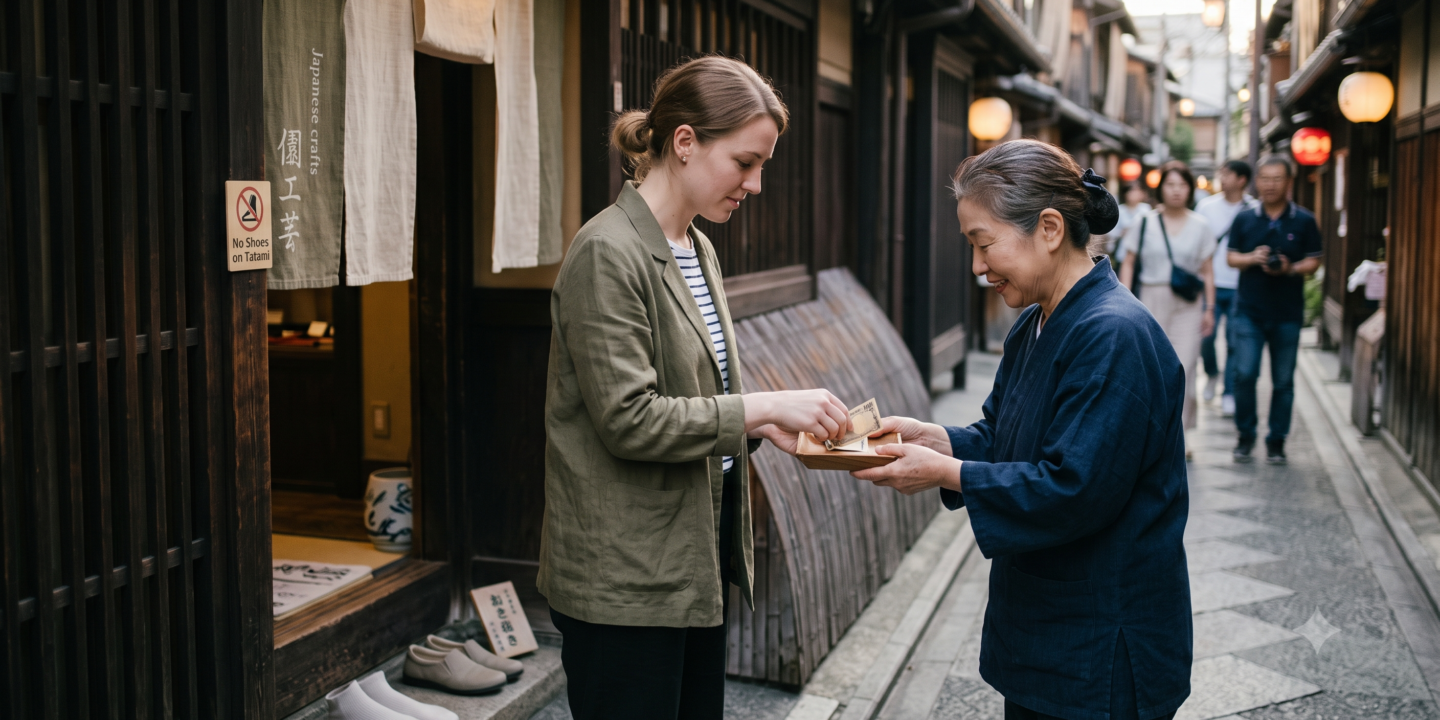
Tipping (chippu) does not exist in standard Japanese commercial life. Excellent service is considered the baseline standard of every job, from five-star Michelin ryokans to modest underground ramen counters.
Why Cash Tips Cause Confusion
If you leave loose coins or paper yen on a restaurant table, the staff will assume you accidentally forgot your change.
Waiters have been known to run a block down the street in the rain just to return a 500-yen coin left on a table. It also introduces awkwardness, as employees have no accounting mechanism to log or distribute tips among workers.
In Japanese hospitality, a worker takes personal pride in executing their role flawlessly without needing financial incentives. Offering extra money can accidentally suggest that you think the business does not compensate its workers fairly.
How to Show Genuine Gratitude
Pay the exact total shown on your bill at the front cash register, not at your table.
Place your money directly into the small change tray (tsuri-tai) on the counter using both hands, rather than handing it to the cashier directly.
Offer a respectful nod or a slight bow as you take your change and receipt.
Say “Gochisousama deshita” (go-chee-so-sah-mah deh-she-tah), which translates warmly to “Thank you for the feast.”
Mistake 3: Making Phone Calls or Talking Loudly on Trains
Japan operates arguably the cleanest, most punctual railway network in the world. Whether riding the Tokyo Metro or traveling across the country on the Shinkansen, you will notice one constant: utter silence.
Public transit is viewed as a collective relaxation space. Commuters use transit hours to decompress, read, or catch up on sleep after demanding workdays.
+-------------------------------------------------------------+
|                     TRAIN ETIQUETTE RULES                   |
|                                                             |
|   [ SILENT MODE ]      [ NO PHONE CALLS ]    [ PACK TO LAP] |
|   Set phone to         Keep voice calls to   Wear backpack  |
|   "manner mode"        the vestibules on     in front or    |
|   upon boarding.       bullet trains.        on luggage rack|
+-------------------------------------------------------------+
The Annoyance of Audio Leakage and Phone Calls
Speaking on a mobile phone on a commuter train is seen as inconsiderate. It forces nearby passengers to overhear one half of a conversation in an enclosed, quiet space.
Even carrying on a loud conversation with your travel companions disrupts the shared calm. Locals rarely raise their voices in train cars, keeping conversations to low whispers.
Leaking audio from your headphones is another frequent annoyance. Because train cars are so quiet, tinny treble beats escaping from cheap earbuds can be heard several rows away.
Transit Etiquette Guidelines
- Switch your phone to silent mode (known in Japan as “manner mode”) the moment you step onto the station platform.
- Avoid answering incoming voice calls. If an urgent call comes through, decline it and send a quick text message explaining that you are on the train.
- If you are traveling on the Shinkansen and must take an urgent business call, walk to the enclosed vestibule area between train cars to speak quietly.
- Remove your backpack and hold it in your hands, place it on your lap, or stow it on the overhead racks to keep aisles clear during rush hour.
- Avoid occupying priority seats (yusenseki) unless you have mobility needs, and yield them immediately to elderly passengers, expectant mothers, or injured travelers.
Mistake 4: Walking While Eating or Drinking (Aruki-Kui)
Convenience stores (konbini) like 7-Eleven, Lawson, and FamilyMart offer exceptional grab-and-go food, from warm fried chicken (karaage) to fresh tuna onigiri. However, walking down the sidewalk while eating or drinking (aruki-kui) is widely considered poor form.
The main issue comes down to cleanliness, street safety, and waste management.
The Problem of Food Mess and Missing Trash Cans
Eating while walking raises the risk of bumping into someone and staining their clothing with sauce or drinks. It is also viewed as ungraceful, reflecting a lack of appreciation for the food you are consuming.
A practical problem quickly follows: public trash cans are virtually nonexistent on city streets in Japan.
Following the 1995 Tokyo subway sarin gas attacks, authorities removed most public rubbish bins for security purposes. Ever since, citizens have routinely carried their trash home with them in a small bag.
Convenience Store (Konbini) / Vending Machine
  │
  ├─> Option A: Eat inside designated store seating area
  ├─> Option B: Consume snack directly outside the storefront
  └─> Option C: Finish drink next to the vending machine bin
Best Practices for Snacking on the Go
- Eat your snack right outside the convenience store where you bought it, or use the small indoor seating counter if the shop provides one.
- When purchasing canned drinks or bottled teas from outdoor vending machines, drink them right there. Deposit the empty container in the recycling bin attached directly to the machine’s side.
- If you purchase street food at an outdoor market like Tsukiji Outer Market in Tokyo or Nishiki Market in Kyoto, stand in front of that vendor’s stall until you finish eating. Hand the wooden skewers or wrappers back to the vendor for disposal.
- Carry a small plastic bag inside your daypack to hold sweet wrappers, tissue paper, and bottle caps until you return to your hotel room.
Mistake 5: Wearing Shoes in Genkan Entryways and on Tatami Mats
Few cultural boundaries in Japan are as clear-cut as the division between inside (uchi) and outside (soto).
The outside world is viewed as unclean and full of grime, while the home, traditional inn, or temple interior is a protected sanctuary. Wearing outdoor shoes indoors is seen as tracking dirty streets into clean living spaces.
Traditional woven rush straw (tatami) mats require extra care. They are soft, delicate, and impossible to scrub with water once stained.
========================= [ CLEAN INDOOR LEVEL ] =========================
                  (Socks or Bare Feet on Tatami Mats)
                  (House Slippers on Polished Hardwood)
--------------------------------------------------------------------------
   GENKAN STEP (10-20 cm step up: Turn shoes around, facing out)
--------------------------------------------------------------------------
======================== [ DIRTY ENTRANCE LEVEL ] ========================
                 (Outdoor Footwear Removed Here Only)
The Rules of the Genkan
Whenever you enter a private home, traditional inn (ryokan), temple hall, or old-school izakaya, you will encounter a sunken entrance area called a genkan.
This step serves as the physical border between outdoor grit and indoor cleanliness:
- Step onto the sunken tile area and untie or slip off your shoes.
- Step up onto the raised wood floor in your socks without letting your socks touch the lower floor where dirty shoes sit.
- Turn your shoes around so the toes point toward the outside door, and tuck them neatly into the wooden shoe cubbies (getabako).
- Put on the house slippers provided by your host for walking down polished hardwood hallways.
The Sacred Rule of Tatami
Never wear house slippers onto tatami mats. Slippers have firm soles that crush the delicate rush reeds, causing them to fray and degrade over time.
Step out of your indoor slippers at the edge of the tatami room and enter in your socks or bare feet.
Always pack clean, presentable socks that have no holes or thinning heels, as you will be taking off your footwear multiple times every single day.
Expanding Your Cultural IQ: More Japan Travel Etiquette Tips
While avoiding the big five mistakes will keep you out of trouble, learning a few additional cultural norms will help you travel with ease.
1. Onsen (Hot Springs) Etiquette and Tattoos
Traditional communal baths (onsen) have strict hygiene requirements that every bather must follow:
- Wash thoroughly at the seated shower stations with soap and shampoo before ever stepping into the communal pool.
- Rinse off all soap bubbles before getting in; soapy residue in the thermal water is a major offense.
- Keep your modesty towel out of the bath water. Balance it on your head or place it on the rock ledge nearby.
- Tattoos historically carried ties to the Japanese organized crime syndicates (yakuza). While younger locals understand that foreigners get tattoos for fashion, many traditional baths still enforce strict tattoo bans.
- Look for modern tattoo-friendly baths, book private family baths (kashikiri), or use flesh-colored waterproof bandages to cover small ink work.
2. Elevator and Escalator Etiquette
In bustling transport hubs like Shinjuku Station, commuter traffic relies on clear lane discipline:
- In Tokyo and Eastern Japan, stand on the left side of the escalator and leave the right side open for people walking up.
- In Osaka and parts of the Kansai region, stand on the right and pass on the left.
- If you are unsure which side to choose, pause and follow the lead of the locals standing ahead of you.
- When stepping into an elevator, the person closest to the control panel holds the door-open button until all passengers board or exit.
3. Temple and Shrine Manners
Shinto shrines (jinja) and Buddhist temples (otera) look similar to first-time travelers, but they carry distinct customs:
+------------------------------------+------------------------------------+
|       SHINTO SHRINE PROTOCOL       |      BUDDHIST TEMPLE PROTOCOL      |
+------------------------------------+------------------------------------+
| 1. Bow once before torii gate.     | 1. Bow slightly at the outer gate. |
| 2. Purify hands at water basin.    | 2. Purify hands at water basin.    |
| 3. Toss coin into offering box.    | 3. Toss coin into offering box.    |
| 4. Bow deeply twice.               | 4. Bow deeply once.                |
| 5. Clap hands firmly twice.        | 5. Keep hands pressed together.    |
| 6. Say a quiet prayer.             |    (Do NOT clap your hands).       |
| 7. Bow deeply one final time.      | 6. Bow slightly upon leaving.      |
+------------------------------------+------------------------------------+
Practical First-Time Japan Travel Tips
Beyond social customs, practical trip planning keeps your travels stress-free and compare affordable airfares.
Carry Physical Cash Everywhere
Japan has adopted contactless cards and smartphone payments quickly, but cash remains essential across the country.
Small ramen stalls, coin lockers, neighborhood bakeries, temple entry gates, and rural buses frequently take cash only. Keep 5,000 to 10,000 yen in paper notes on hand each day.
Seven Bank ATMs inside 7-Eleven stores accept foreign debit cards reliably, offering low withdrawal fees and English-language screens.
       ESSENTIAL WALLET BREAKDOWN FOR DAILY TRAVEL
+-------------------------------------------------------+
|  [ 10,000 Yen Notes ]  Large purchases, hotel bills   |
|  [  1,000 Yen Notes ]  Ramen shops, casual lunches    |
|  [ 100 & 500 Coins  ]  Coin lockers, local bus fares  |
|  [ Digital Transit  ]  Suica / Pasmo for subways      |
+-------------------------------------------------------+
Master the Digital IC Card (Suica / Pasmo)
Skip paper train tickets by adding a digital transit card (such as a Suica or Pasmo) to your phone’s digital wallet before landing.
You can top up these cards using your stored credit card, allowing you to tap smoothly through turnstiles across nationwide subway and rail networks.
You can also use your IC card balance to buy drinks at vending machines and pay for goods inside convenience stores.
Book Long-Distance Shinkansen Luggage Space Early
Japan Rail enforces strict baggage dimensions on the Tokaido, Sanyo, and Kyushu Shinkansen lines running between Tokyo, Nagoya, Kyoto, and Osaka.
If the total dimensions (length + width + height) of your suitcase fall between 161 cm and 250 cm, you must book an oversized baggage seat in advance.
Bringing an oversized suitcase aboard without a prior reservation brings a 1,000-yen penalty, and staff will move your bag to a designated storage bay.
Rent Pocket Wi-Fi or Install an eSIM
Navigating complex subway layouts, reading Japanese street signs, and checking train departures on Google Maps demands dependable internet access.
Pick up a pocket Wi-Fi router at Haneda, Narita, or Kansai Airport, or download an eSIM profile to your smartphone before leaving home.
Frequently Asked Questions
What happens if I make a mistake as a foreign tourist in Japan?
Locals do not expect foreign tourists to understand every nuance of their cultural customs. The Japanese culture operates on gaijin no resupetto (giving grace to outsiders).
If you make an honest mistake, offer a polite bow, say “Sumimasen” (excuse me / sorry), and adjust your behavior. Sincere goodwill and a respectful attitude go a long way.
Is blowing your nose in public considered rude in Japan?
Yes, loudly blowing your nose into a tissue in public spaces, particularly on trains, inside restaurants, or in crowded areas, is viewed as unhygienic.
If you have a cold or allergies, step into a restroom stall to blow your nose. Otherwise, wear a face mask, which is standard practice across Japan.
Can I drink tap water safely anywhere in Japan?
Yes, tap water is completely safe to drink everywhere in Japan. Water quality standards are exceptionally high.
Feel free to refill your reusable water bottle at hotel taps, public drinking fountains, and transit stations without hesitation.
How should I dress when visiting temples and shrines?
While Japanese religious sites do not enforce the strict dress codes found across Southeast Asia, dressing modestly shows respect.
Avoid revealing clothing, such as low-cut tops, short shorts, or unbuttoned shirts, when visiting holy shrines and temples. Choose comfortable, slip-on shoes, as you will take your footwear off when entering wooden temple halls.
Is bargaining or haggling acceptable in Japanese shops?
No, haggling over prices is not part of Japanese retail culture. The price listed on the shelf tag or menu is fixed and non-negotiable.
Attempting to negotiate discounts in department stores, mom-and-pop shops, or restaurants will cause discomfort for the staff. The only exceptions are flea markets, second-hand electronic shops in Akihabara, or wholesale fish markets.
Final Thoughts: Embrace the Journey with Humility
Traveling across Japan offers one of the most rewarding adventures in the world. The country’s unique harmony between timeless customs and hyper-modern efficiency is unmatched.
By avoiding these five common travel mistakes, you show genuine respect for the people hosting you. Travel with an observant eye, step gently into their daily rhythms, and approach every interaction with humility.
Your trip will reward you with deep cultural connections and memories that last a lifetime.