

This post contains affiliate links. If you buy through them, Ease Advise may earn a small commission at no extra cost to you.
Short answer: for most Indian car owners, a front-and-rear dash cam with a supercapacitor (not a lithium battery), at least Full HD video, a field of view of roughly 130–160 degrees and a high-endurance microSD card is the sensible starting point. Add a hardwire kit only if you want parking mode. Here is why, based on published specifications and established buyer guides.
Front, front + rear or 3-channel?
A dash cam mounts near the windscreen and keeps recording the road ahead. Many systems add a rear camera, and some add a cabin-facing or 360-degree camera.
- Front only: simplest and cheapest to fit; covers the road ahead.
- Front + rear (2-channel): also records rear-end bumps, which are common in stop-start city traffic. Needs a cable routed to the rear glass. Search for a front and rear dash cam on Amazon and check the current price.
- 3-channel (front + rear + cabin): useful for cab and fleet drivers. More cables and storage, and passengers should be told they are being recorded. See 3-channel dash cams on Amazon.
Comparison: dash cam types and key features
| Feature / type | What it does | Who needs it | Watch out for |
|---|---|---|---|
| Front only | Records the road ahead | Private cars, first-time buyers | No record of rear impacts |
| Front + rear | Adds a rear-glass camera | City commuters, family cars | Rear cable routing; tinted or wet rear glass |
| 3-channel | Adds a cabin camera | Cab, rental and fleet drivers | Passenger privacy; more storage needed |
| Supercapacitor | Short power buffer to save the last clip | Hot climates, outdoor parking | Needs a hardwire kit for parking mode |
| Lithium battery | Runs briefly without car power | Cooler regions, covered parking | Heat ageing and swelling over time |
| GPS | Stamps location on video | Highway drivers, insurance records | Some models need an external GPS module |
| Wi-Fi app | View and download clips on your phone | Almost everyone | Short range; not remote viewing |
| Parking mode | Records motion or impact while parked | Street or open-lot parking | Needs constant power and a voltage cutoff |
Resolution, sensor and night video
Full HD (1080p) is the practical minimum, and an Indian enthusiast buyer’s guide on The Automotive India forum suggests 2K or 4K where the budget allows. The same guide warns that real-world footage is often a little below what the box claims, so look at sample videos from actual owners rather than the headline number alone.
Frame rate matters too. 30 frames per second is standard. 60fps can make number plates easier to read at a distance, but roughly doubles the storage each minute of video takes.
For night driving, the lens and sensor matter more than resolution:
- Aperture: a lower f-number lets in more light. The forum guide cites f/1.4 to f/2 as the useful range.
- Lens material: multi-element glass lenses are preferred over plastic ones.
- Headlight glare: poor exposure handling lets oncoming headlights wash out plates; owner night clips show this best.
- CPL filter: a polarising filter cuts daytime windscreen reflection but can darken night footage, so remove it for regular night driving.
Field of view
A wider lens catches more lanes, but very wide angles distort the edges and shrink distant plates. The Automotive India guide puts the ideal range at about 130 to 160 degrees.
Heat tolerance: supercapacitor vs battery
Heat matters most for Indian buyers: a car parked in the summer sun gets very hot behind the windscreen, exactly where the camera sits.
- Lithium-polymer battery models: mostly found in cheaper cameras. Wikipedia’s dashcam entry notes these batteries typically last about 2–3 years and can swell as they age, causing random shutdowns or card format errors.
- Supercapacitor models: last longer and tolerate heat better, though they usually cost more. The Automotive India guide cites a typical supercapacitor rating of -25°C to +85°C and says battery cameras exposed to the sun are unsuitable for Indian conditions.
A supercapacitor only stores enough energy to save the last file when power is cut, so parking mode still needs a hardwire kit. Always check the operating temperature on the maker’s spec sheet. Browse supercapacitor dash cams on Amazon and confirm the rating on the listing.
Memory cards and loop recording
Dash cams record in short clips (typically 1–3 minutes) and loop: when the card is full, the oldest unlocked clip is overwritten. A G-sensor locks a clip when it detects a jolt, so it is not overwritten. Set the sensitivity sensibly, because on Indian roads a high setting will lock clips at every speed breaker and fill the card.
Constant rewriting wears out ordinary cards, so use a high-endurance card made for dash cams and CCTV. As an example of what to look for, Samsung’s PRO Endurance 128GB card (as listed on Samsung’s Australian site, checked 28 October 2026) is rated for up to 70,080 hours of Full HD recording at 26Mbps, operates from -25°C to 85°C, carries U3/V30 speed ratings and has a limited five-year warranty. Endurance hours and warranty length vary by capacity and region, so check the figures for the size you buy.
- Capacity: 32GB or 64GB at minimum; 128GB or more is better for 2-channel or 4K cameras.
- Speed: Class 10 is enough for 1080p; choose V30 for 4K.
- Warranty: some standard cards exclude continuous recording from their warranty, so read the terms.
Find a high endurance microSD card on Amazon and check the current price.
GPS and the Wi-Fi app
GPS stamps location coordinates on your footage, which helps show where and how an incident happened. Some cameras have GPS built in; others need a separate module, so check before buying.
Wi-Fi lets you save clips to your phone without removing the card. It is a short-range link, typically around 10–15 feet, so it does not let you watch the camera from home; remote alerts need a model with 4G or cloud support. Our guide on securing your home Wi-Fi network covers password basics that also apply here.
Power options, parking mode and hardwiring
There are two common ways to power a dash cam:
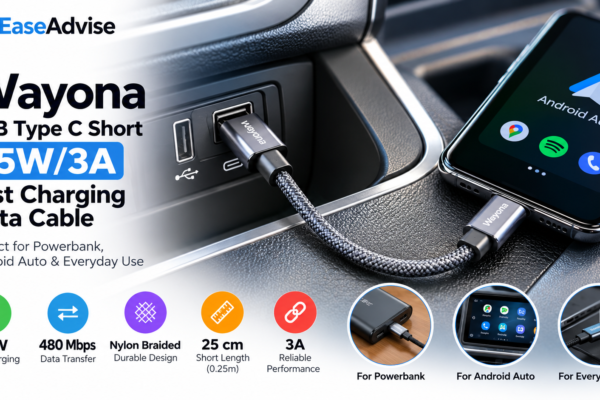
- 12V accessory socket: the easy option. Most cameras use a 5V, 1.5–2A USB adapter, so they switch off with the ignition. Some cars keep the socket live after shutdown, which can drain the battery, so check yours. Use a good-quality cable; our Wayona USB Type-C cable review looks at one option for car use.
- Hardwire kit: connects to the fuse box, frees up the socket, hides the cables and enables parking mode.
Parking mode keeps the camera watching for motion or impact while the car is off. A typical hardwire kit has three wires: one to a constant (always-on) fuse, one to a switched (ignition) fuse, and a ground to bare chassis metal. A good kit also has a low-voltage cutoff that turns the camera off before your car battery runs too low. On Garmin’s parking-mode kit, for example, the default cutoff is 11.7V, with 12.0V or 12.3V options. Garmin recommends an experienced installer, since wrong wiring can damage the car or battery. Search dash cam hardwire kits on Amazon, but buy the kit made for your camera brand where possible.
Parking mode cannot help someone reach you if you are blocking a gate; a QR sticker such as EaseTag lets people alert you without seeing your number.
How to choose: a quick checklist
- Decide on channels: front only, front + rear, or 3-channel for cab/fleet use.
- Pick a supercapacitor model and check the operating temperature on the spec sheet.
- Choose Full HD at least; 2K or 4K if you want clearer plates.
- Look for a wide aperture (around f/1.4–f/2) and a glass lens for night video.
- Keep the field of view around 130–160 degrees.
- Budget for a high-endurance microSD card (V30 for 4K).
- Confirm GPS is built in or included if you want location records.
- Want parking mode? Add a brand-matched hardwire kit with a voltage cutoff and use a trained installer.
- Plan an adhesive mount near the centre of the windscreen; a matte anti-glare film is better than a glossy one.
- Watch real owner night clips before buying, and keep the original, unedited file of any incident.
FAQ
Is a battery dash cam bad for Indian summers?
Not always, but lithium batteries age faster in heat and can swell over time. A supercapacitor model is the safer choice if your car is parked in the sun.
Can I watch my dash cam live from home over Wi-Fi?
No. Built-in Wi-Fi only links to your phone at close range. Remote viewing and alerts need a model with 4G or cloud connectivity.
Will parking mode drain my car battery?
It can if wired without protection. Use a hardwire kit with a low-voltage cutoff and set a higher cutoff if your battery is old or the car stands for days.
Bottom line
For Indian conditions, heat tolerance comes first: choose a supercapacitor camera, pair it with a high-endurance card, and aim for at least Full HD with a bright lens and a 130–160 degree view. Add a rear camera if you drive mostly in city traffic, and a hardwire kit only if you genuinely need parking mode. Get those basics right and the extras matter far less.
Sources
- The Automotive India: The Dashcam Buyer’s Guide
- Wikipedia: Dashcam
- Samsung Australia: PRO Endurance microSD Card 128GB
- The Dashcam Store: Garmin Parking Mode Kit (USB-C direct-wire power cable)