

This post contains affiliate links. If you buy through them, Ease Advise may earn a small commission at no extra cost to you.
The short answer: for most people in India, a 10,000 mAh or 20,000 mAh power bank with USB-C Power Delivery (PD) is the right buy. It is light enough for daily use, it stays well under the 100 Wh limit that airlines allow without approval, and it can fast-charge a modern phone. Go bigger only if you need to top up a laptop, and remember that, as of 28 October 2026, you can carry a power bank on Indian flights but you cannot use it in the air.
mAh vs Wh: the number that actually matters
Shops sell power banks by mAh (milliamp-hours), but airlines and regulators use Wh (watt-hours), which measures energy. Anker’s support guide gives the conversion: Wh = (mAh ÷ 1,000) × cell voltage. Most lithium-ion cells have a nominal voltage of 3.7 V, so a 20,000 mAh power bank holds about 74 Wh.
If the casing prints a Wh figure, trust it over your own sum; that is the rating security staff look for.
Why a 20,000 mAh bank does not give you 20,000 mAh
Two losses eat into the headline figure. First, the circuit inside the power bank boosts the 3.7 V cells up to 5 V (or higher for fast charging), and Anker puts that conversion at roughly 80–85% efficient. Second, your phone loses some energy as heat while it charges, which Anker estimates at about 10–20%.
In Anker’s worked example, a 20,000 mAh bank (74 Wh) delivers about 60.7 Wh after conversion. That is roughly 2.8 full charges of a phone with an 18.2 Wh battery, or about half a charge of a 100 Wh laptop battery. This loss is normal, not a fake rating.
Capacity bands compared
Wh values below use the 3.7 V formula; usable energy and phone charges scale Anker’s 20,000 mAh example. Flight rules are as of 28 October 2026 and can differ by airline.
| Capacity | Approx. Wh (3.7 V) | Rough phone charges (18 Wh phone) | Typical use | Flight allowance |
|---|---|---|---|---|
| 10,000 mAh | 37 Wh | About 1.4 | Pocket backup for a day out or a short trip | Allowed in cabin bag, no approval |
| 20,000 mAh | 74 Wh | About 2.8 | Weekend trips, two devices, a partial tablet top-up | Allowed in cabin bag, no approval |
| 27,000 mAh | About 99.9 Wh | About 3.8 | Largest size that stays just under 100 Wh; can part-charge a laptop | Allowed only if the printed rating is 100 Wh or less |
| 30,000 mAh | About 111 Wh | About 4.2 | Heavy laptop or multi-device use | 100–160 Wh band: needs airline approval; IndiGo limits this band to portable medical devices |
| 45,000 mAh and above | About 166 Wh or more | n/a | Camping, outdoor or home backup only | Over 160 Wh: not allowed on passenger flights |
Fast charging: PD, Quick Charge and wattage
USB Power Delivery is the common fast-charging standard over USB-C. According to the USB Implementers Forum (USB-IF), USB PD was capped at 100 W (20 V with a 5 A-rated cable) until Revision 3.1, announced in 2021, raised the maximum to 240 W.
- Phones: check the maximum charging wattage your phone maker lists and pick a power bank whose PD output meets it; paying for much more gives no benefit to the phone. Some Android brands also use Qualcomm Quick Charge or their own proprietary protocols, so check which one your phone supports before paying extra.
- Tablets and small laptops: look at the wattage printed on your laptop’s own charger and pick a power bank whose USB-C PD output matches or comes close.
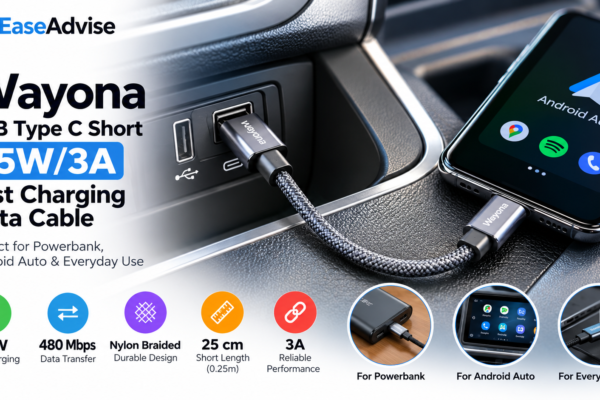
- Cables matter: per USB-IF, 100 W charging needs a cable rated for 5 A. A cheap cable can quietly limit your speed. Our Wayona 65W USB-C cable review explains what a 3 A cable can and cannot do.
Ports and pass-through
Prefer a two-way USB-C port (input and output), so one cable charges both the bank and your phone; a USB-A port helps with older gadgets. Output is usually shared when two devices charge together, so check the per-port wattage in the listing.
BIS registration: check before you buy
Power banks sold in India fall under the Compulsory Registration Scheme (CRS) run by the Bureau of Indian Standards with MeitY. Compliance guides list the safety standard as IS 13252 (Part 1):2010. A registered product carries the BIS Standard Mark with an R-number.
To verify, open the official BIS Care app, choose “Verify R-No under CRS” and enter the eight-digit R-number from the product or box; it shows the registered manufacturer. The app also takes complaints about misuse of the mark. No R-number, or one that does not match the brand? Skip it.
Flying with a power bank: the rules as of 28 October 2026
India: DGCA advisory (reported 4 January 2026)
- You cannot use a power bank to charge any device during the flight.
- You cannot plug a power bank into the seat power socket.
- Power banks and spare lithium batteries go in hand baggage only, never in checked bags, and not in the overhead bin. Keep them in the seat pocket or under the seat.
- Report any heat, smoke or strange smell from a device to cabin crew straight away.
News reports of the advisory did not quote a circular number, and outlets differ on whether it set a firm 100 Wh cap for all passengers. Treat 100 Wh as the safe ceiling.
One model banned: MOBIKINS MK-PB-04 (14 October 2026)
On 11 October 2026, a power bank caught fire in an overhead bin on IndiGo flight 6E 6115 from Delhi to Chennai, and the aircraft diverted to Hyderabad, where it landed safely. Within days, the DGCA barred the MOBIKINS MK-PB-04 power bank from flights to, from and within India, as passenger baggage and as cargo, according to reports on 14 October 2026. This applies to that model only and is not a blanket ban.
International: ICAO two-power-bank limit (from 27 March 2026)
Since 27 March 2026, an ICAO rule limits passengers to two power banks in the cabin and bans recharging them on board. Airline Ratings reports that Air India, Emirates, Singapore Airlines and others have aligned with it. Emirates is stricter: one power bank under 100 Wh, with no in-flight use since 1 October 2025.
Airline limits at a glance
- Up to 100 Wh: allowed in the cabin without approval. IndiGo allows up to two; Air India allows up to two per passenger.
- 100–160 Wh: needs airline approval. IndiGo’s policy, as reported, allows this band only for portable medical devices, approved at check-in.
- Above 160 Wh: not allowed on passenger aircraft.
Packing your cabin bag anyway? Our cabin bag food guide covers the other items that trip people up at security.
How to choose: practical steps
- Size it to your day. Commuters and students: 10,000 mAh. Travellers and heavy users: 20,000 mAh. Laptop users: up to about 27,000 mAh, with the label showing under 100 Wh. Compare 10,000 mAh PD power banks or 20,000 mAh PD power banks on Amazon and check the current price.
- Check the Wh on the casing. If you fly, the printed Wh rating should be 100 Wh or less. No rating printed means a risk of being stopped at security.
- Match the wattage. For laptops, pick a PD output close to your laptop charger’s rating, for example a 65W PD laptop power bank, plus a 100W-rated USB-C cable.
- Verify the BIS R-number in the BIS Care app before or right after buying.
- Before you fly, charge your phone fully at the airport, keep the bank switched off in the seat pocket, and read your airline’s current dangerous-goods page, since airlines can be stricter than the regulator.
Safety habits
The fire risk comes from “thermal runaway”, where a fault makes a lithium cell heat up rapidly. Stop using any bank that swells, gets unusually hot or smells. Keep each one in its own pouch, away from keys and coins that could short the ports.
FAQ
Can I carry a 20,000 mAh power bank on a domestic flight in India?
Yes. At about 74 Wh it is under the 100 Wh limit. Carry it in your hand baggage, keep it out of the overhead bin, and do not use it during the flight.
Can I charge my phone from my power bank on the plane?
Not on flights in India since the DGCA advisory reported on 4 January 2026, and not on many international airlines. Charge your phone fully before boarding instead.
Is a 30,000 mAh power bank allowed?
At around 111 Wh it falls in the 100–160 Wh band, which needs airline approval. IndiGo, as reported, allows that band only for medical devices, so for most travellers a bank rated under 100 Wh is the safer choice.
Bottom line
Buy by Wh and wattage, not by the biggest mAh number. A BIS-registered 10,000 or 20,000 mAh USB-C PD power bank suits most Indian buyers and flies without paperwork. Need laptop power? Stay at or under 100 Wh and match the PD output to your charger. On board, as of 28 October 2026, keep it in your hand bag and under the seat, switched off, and check your airline’s rules before every trip. If you are planning one soon, our flight deals page is a good place to start.
Sources
- India TV News: Flight safety alert: DGCA bans power banks for in-flight charging
- Aviation A2Z: India bans power bank use on flights under new advisory
- Telangana Today: DGCA prohibits specific MOBIKINS powerbank after fire incident on IndiGo flight
- The Week: Delhi-Chennai IndiGo passengers rush to put out power bank fire; flight diverted to Hyderabad
- Esquire India: Power bank rules for flights in India: IndiGo vs Air India
- Airline Ratings: New airline power bank rules: what passengers need to know
- Wego: Only two power banks allowed, no charging mid-flight: new rules in 2026
- Anker Support: Why is the rated capacity of power banks lower than expected?
- USB-IF: USB Charger (USB Power Delivery)
- Bureau of Indian Standards: BIS Care app
- Corpbiz: BIS CRS registration for power bank