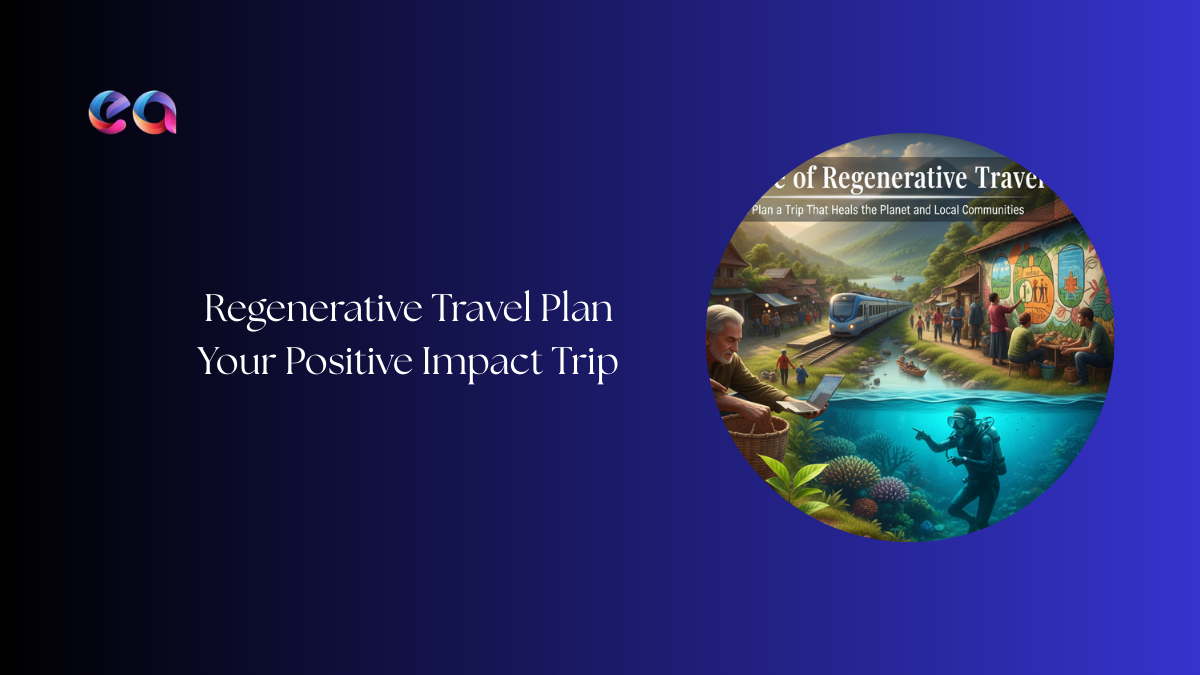


For decades, the goal of responsible tourism was to sustain a destination—to leave no trace, minimize impact, and ensure that a place remained as it was found. This ideal, known as sustainable travel, was a necessary and vital evolution from mass tourism. Yet, in a world grappling with the accelerating effects of climate change, biodiversity loss, and economic inequality, simply “sustaining” is no longer sufficient.
The contemporary traveler, particularly the conscious traveler and the digital nomad who lives and works across borders, is seeking a deeper, more active commitment. This movement is called Regenerative Travel.
Regenerative travel is a profound shift in philosophy: it’s the intention to leave a place better than you found it. It asks travelers and the tourism industry to move from a neutral impact model (sustainability) to a positive impact model (regeneration). It is not just about reducing your carbon footprint; it is about planting new roots—both literal and metaphorical—to actively restore, renew, and enhance the environment, culture, and social well-being of the host community. This comprehensive guide will deconstruct the principles of this philosophy and provide a practical, actionable framework for planning your next trip as a regenerative journey. This is more than a trend; it is the future of travel, positioning the visitor not as a consumer, but as a co-creator of a vibrant, resilient destination.
Table of Contents
Part 1: Defining the Movement
Regenerative vs. Sustainable Travel: Understanding the Critical Difference
The terms sustainable and regenerative are often used interchangeably, but their philosophies are fundamentally distinct. Grasping this difference is the first step in becoming a regenerative traveler.
| Feature | Sustainable Travel | Regenerative Travel |
| Core Goal | To minimize negative impacts and preserve the status quo. | To create a net-positive impact and actively restore/renew the destination. |
| Mindset | Treading lightly (avoiding harm). | Giving back (creating positive change). |
| Focus | Minimizing carbon emissions, waste, and resource use. | Restoring ecosystems, empowering local governance, and revitalizing culture. |
| The Analogy | Walking carefully around a meadow to avoid stepping on flowers. | Watering the flowers, planting new seeds, and nourishing the soil. |
While sustainable tourism is focused on minimizing the negative footprint, regenerative travel is an action-based approach aimed at improving the environmental, social, and economic health of a destination. It is a philosophy rooted in the concept of holistic restoration—recognizing that the health of the community, the culture, and the ecosystem are all interconnected.
Bestseller #1

Bestseller #2

Bestseller #3

Bestseller #4

The Problem Regenerative Travel Aims to Solve
For decades, mass tourism has followed a largely extractive model. This model prioritizes short-term profit and high visitor volume, leading to several detrimental effects:
- Overtourism and Congestion: Fragile natural and historical sites are damaged by excessive foot traffic, and the quality of life for residents in popular cities deteriorates due to congestion and rising costs.
- Economic Leakage: A significant portion of tourist money (often up to 80%) leaves the local economy, going to international hotel chains, foreign-owned tour operators, and imported goods.
- Cultural Commodification: Local traditions and authentic experiences are often turned into contrived performances for tourist consumption, eroding the true cultural identity of a place.
- Environmental Degradation: Increased waste, pollution, and strain on water/energy resources in destinations that were not built to handle mass-scale consumption.
Regenerative travel directly confronts this by demanding a relationship of reciprocity between the traveler and the host destination.
Part 2: The Core Pillars of Regenerative Travel
To plan a regenerative trip, you must look beyond basic eco-practices and understand the three core areas of positive impact: Ecosystems, Economy, and Community.
Pillar 1: Ecosystem Restoration (Healing the Land)
This goes beyond merely recycling in your hotel room; it involves hands-on contributions to the natural environment.
A. Active Conservation and Reforestation
Look for opportunities to engage with local, science-based conservation projects.
- Example 1: Coral Reef Rehabilitation: In coastal destinations like the Philippines or the Caribbean, travelers can work directly with marine biologists to transplant coral fragments to damaged reefs. This activity is often a structured, multi-day experience with local NGOs.
- Example 2: Tree Planting and Reforestation: Supporting organizations that focus on native-species reforestation is crucial. In places suffering from deforestation, a traveler can dedicate a day to planting native trees, helping to restore local biodiversity and improve soil health.
- Example 3: Citizen Science Initiatives: Participate in data collection, such as monitoring local bird populations, tracking marine life migrations, or conducting biodiversity surveys in national parks. Your time becomes a measurable input for conservation research.
B. Water and Waste System Stewardship
The impact of water usage in arid or water-stressed destinations is immense.
- Conscious Water Use: In many regions, the water used for a single hotel pool could supply a local family for weeks. Choose accommodations with greywater recycling systems and low-flow fixtures.
- Zero-Waste Focus: Commit to zero-waste packing. This includes bringing reusable water filters (like those found in purification bottles) to eliminate the need for plastic bottles, and carrying reusable containers for street food and market purchases.
Pillar 2: Economic Reinvestment (Empowering Local Business)
Regenerative economic impact ensures that the financial benefits of tourism are broadly distributed and empower the local community, rather than being siphoned off by external corporations.
A. The Power of Local Ownership
The core principle is simple: Direct your spending to locally-owned, non-extractive businesses.
- Accommodation: Opt for family-run guesthouses, alberghi diffusi (a scattered hotel model that revitalizes abandoned homes in historic villages, integrating tourists into the community), or small, independent eco-lodges that hire and train local staff.
- Dining: Prioritize farm-to-table restaurants that source ingredients from within a short radius, or visit local markets. This practice not only supports small farmers but also preserves culinary traditions and reduces transportation emissions.
- Tour Operators: Book excursions with community-led co-ops or Indigenous-owned businesses. These groups often have unparalleled local and ecological knowledge, ensuring a more authentic experience while keeping the profit directly within the community.
B. Fair Trade and Artisan Support
Avoid souvenir shops that sell mass-produced goods. Seek out certified Fair Trade artisan cooperatives or direct-to-maker workshops. This supports skills preservation and ensures makers receive a fair wage for their craft, which is a powerful way to preserve cultural heritage while creating economic resilience.
Pillar 3: Cultural & Community Reciprocity (Honoring the Place)
The regenerative philosophy views the host community not as a backdrop for a vacation, but as the steward of the destination. True regeneration must benefit the people who call the place home.
A. Engaging with Intention
Shift your approach from “taking a picture” to “making a connection.”
- Learn the Language: Even a few phrases of the local language (“Hello,” “Thank you,” “Excuse me”) demonstrate profound respect and often unlock genuine, positive interactions.
- Understand Local Protocol: Research and adhere to local customs regarding dress, photography, and interaction with elders or sacred sites. For instance, in many cultures, taking a photo of a person without explicit permission is considered highly offensive.
B. Community-Led Cultural Exchange
Seek out experiences where the local community retains control over the narrative and presentation of their culture.
- Experiential Learning: Participate in workshops led by locals—a cooking class focused on traditional methods, a weaving lesson with a master artisan, or a storytelling session with village elders. You are learning from the culture, not consuming a staged show.
- Supporting Social Enterprises: Look for non-profits or social enterprises whose mission is to use tourism revenue to fund social projects, such as schools, healthcare clinics, or youth mentorship programs within the host community.
Part 3: The Practical Planning Framework for a Regenerative Trip
Planning a truly regenerative journey requires deliberate research and a shift in priority from convenience to impact. Here is a step-by-step framework.
Step 1: Destination Selection and Purpose
The first choice is the most important: Where and why are you going?
- Avoid Overtourism Hotspots: While you don’t need to avoid popular countries entirely, look past the main attractions. Instead of staying in crowded urban centers, find the second-tier cities or rural areas that are struggling to retain their population or need economic diversification. This directs your money where it can have a greater proportional impact.
- The “Why” Test: Before booking, ask yourself: “What is the destination struggling with, and how can my visit actively help?” If the destination is struggling with water scarcity, focus on low-water-impact choices. If it’s struggling with deforestation, look for planting projects.
Step 2: Transportation and Carbon Budgeting
While air travel is often unavoidable, the regenerative traveler seeks to minimize and offset with verifiable impact.
A. The Principle of Slow Travel
The most regenerative choice is to travel less often, but stay longer.
- Digital Nomad Synergy: This naturally aligns with the Digital Nomad (DN) lifestyle. Instead of three one-week trips, take one three-month trip. This dramatically reduces air travel emissions and allows for deeper community integration.
- Ground Transportation: Prioritize trains, public buses, and local ferries over domestic flights or private car rentals.
B. Meaningful Carbon Offsets
Many carbon offset programs are criticized for being opaque or ineffective. Regenerative travelers prioritize verified, community-embedded offsets.
- Look for Certifications: Seek offsets certified by the Gold Standard or the Verified Carbon Standard (VCS), which ensure the project is permanent, additional (wouldn’t have happened otherwise), and has a social component.
- Direct-Action Contribution: Better still, contribute directly to a local, verified reforestation or ecosystem restoration project in your destination, transforming your ‘offset’ into a direct regenerative contribution.
Step 3: Accommodation Vetting: Beyond the “Eco-Label”
The word “eco-friendly” is often greenwashing. True regenerative accommodation must demonstrate verifiable commitment to all three pillars.
A. Look for Certifications and Benchmarks
Do not trust self-declared labels. Look for third-party verification:
- Global Sustainable Tourism Council (GSTC) Certified: The GSTC provides the gold standard for sustainable and regenerative operations. Its criteria are comprehensive, covering management, social-economic, cultural, and environmental aspects.
- B-Corp Certification: While not travel-specific, a resort or tour operator with B-Corp status commits to balancing profit with purpose and is legally required to consider the impact of its decisions on workers, customers, suppliers, community, and the environment. Playa Viva in Mexico is a notable example, running entirely on off-grid solar power.
- EarthCheck: A specialized benchmarking and certification program for the travel and tourism industry.
B. Key Questions for Accommodation
If a certification is not present, ask these direct questions:
- Water & Energy: Where does your water come from, and what kind of waste-water system is used? What percentage of your energy is supplied by renewable sources?
- Local Staffing: What percentage of your staff are permanent local residents? Is there a clear path for local staff to advance into management roles?
- Procurement: Where do you source your food and supplies? (The answer should be: “From local farmers and artisans within X distance.”)
Step 4: The Regenerative Itinerary: From Sightseeing to Stewardship
Your daily schedule is where regeneration happens. It is the shift from passively viewing a site to actively engaging with its stewardship.
| Traditional Itinerary | Regenerative Itinerary |
| Day 1 AM: Private car transfer to a massive chain resort. | Day 1 AM: Train or public transport to a local guesthouse; spend 30 minutes learning basic phrases. |
| Day 3: Large bus tour of a crowded historical site (e.g., Colosseum). | Day 3: Support a local non-profit by volunteering for a half-day trail maintenance or historical site cleanup. |
| Day 5 PM: Dinner at an internationally recognized restaurant chain. | Day 5 PM: Home-cooked meal at a family-run pousada or attend a local cooking class. |
| Day 7: Buy souvenirs from a duty-free shop at the airport. | Day 7: Purchase a gift from a certified artisan co-op, paying a fair price directly to the maker. |
Practical Activity Examples:
- Hawai’i’s Mālama Hawai‘i Program: Many hotels in Hawaii offer discounts or free night stays if guests participate in a volunteer activity, such as a beach cleanup, forest restoration, or fishpond restoration. This is a clear, institutionalized regenerative incentive.
- Peru’s Rural Homestays: Instead of large hotels near Machu Picchu, choosing a guided multi-day trek that includes homestays in remote villages, where you contribute to farm work or craft production, directly supports the local economy and preserves ancient traditions.
Part 4: The Economic and Social Impact on Local Communities
The promise of regenerative travel is not just about feeling good; it is about tangible, measurable improvements in the local quality of life.
Direct vs. Indirect Economic Benefits
Traditional tourism creates wealth, but it often concentrates it at the top. Regenerative tourism focuses on maximizing the local economic multiplier effect, ensuring money circulates within the community.
| Financial Flow | Traditional Tourism | Regenerative Tourism |
| Accommodation Revenue | High leakage to international headquarters/shareholders. | High retention in the community via local payroll and small business spending. |
| Food & Supply Chain | Imports flown in for hotel menus and gift shops. | Local farmers, fishers, and artisan vendors are prioritized as primary suppliers. |
| Employment | Low-wage, low-skill service jobs for locals; management jobs for expatriates. | Higher-skill, higher-wage jobs for locals (guides, managers, conservationists) with ownership stakes. |
When a regenerative tour operator invests 10% of its revenue back into a local school or a community micro-loan program, that is a direct, measurable act of regeneration that builds social resilience—the community’s ability to thrive and recover from external shocks.
The Preservation of Cultural Sovereignty
A critical element is shifting the power dynamic from the tourist as the “buyer” and the local as the “product” to a relationship of mutual respect.
Community-Centric Planning: In a truly regenerative destination, the local community, often through a dedicated tourism council, has a primary voice in deciding:
- The number of visitors allowed (visitor quotas).
- Which cultural sites are open for viewing and under what conditions.
- How tourism funds are allocated back to community needs.
This protects the community from feeling overwhelmed and exploited, making them genuinely welcoming hosts and proud stewards of their heritage.
Case Study: New Zealand’s Tiaki Promise
New Zealand is a global leader in this shift. The Tiaki Promise is a pledge visitors are asked to take, committing them to care for the land, sea, and nature (treading lightly and leaving no trace), to travel safely, and to respect the local culture. Tiaki means to care for people and place in Te Reo Māori.
This is a powerful regenerative tool because it:
- Sets Expectations: It clearly communicates that visitors are expected to be guardians, not just guests.
- Encourages Reciprocity: It is a symbolic contract that asks the traveler to actively protect what they are enjoying.
- Embeds Cultural Values: It uses the Māori concept of kaitiakitanga (guardianship), ensuring that the cultural value of environmental protection is central to the tourism experience.
Part 5: The Traveler’s Mindset: From Consumption to Contribution
Regenerative travel is, fundamentally, a mindset shift. It requires a degree of humility, curiosity, and a willingness to be uncomfortable in the service of greater good.
1. The Humility of the Learner
Adopt the attitude of a student. When you visit a cultural site or a community, your goal is not to prove how much you know, but to listen and learn. Ask open-ended questions that center on the local perspective:
- “How has tourism changed your community?”
- “What is one thing about your culture you wish visitors understood better?”
- “What is the greatest environmental challenge facing this region?”
This approach turns a transaction into a dialogue.
2. The Acceptance of Imperfection
A regenerative trip will rarely be perfectly seamless or luxurious by traditional standards. You may be using solar power that occasionally runs low, eating locally sourced food that is not to your usual taste, or waiting longer for a local bus.
The Regenerative Pledge: Accept that minor inconvenience is a necessary byproduct of having a positive impact. These moments are where real experience and connection are found. The value of your trip is measured by the quality of your impact, not the thread count of your sheets.
3. The Digital Nomad’s Advantage
As a Digital Nomad (DN), you are uniquely positioned to be a regenerative traveler:
- Extended Stay: Your longer stays inherently reduce travel emissions and allow you to form genuine relationships with the community. You move beyond being a tourist to becoming a temporary resident and an advocate.
- Skill-Based Contribution: You possess valuable professional skills (writing, web design, marketing, finance, teaching). Instead of traditional, often low-skill volunteering, you can seek out opportunities to use your expertise to help local businesses or non-profits build capacity and resilience.
- Local Office Space: Opt for co-working spaces owned by locals or small businesses instead of international chains. Your recurring monthly fee provides stable income for a community-based enterprise.
4. Planning for Post-Trip Advocacy
Regeneration doesn’t stop when you return home. Your journey continues through:
- Amplification: Share your regenerative experiences. Write reviews that highlight the ethical practices of the local businesses you supported. Use your platform (if you have one) to champion the destination and the local partners.
- Financial Follow-Up: Set up a small, recurring monthly donation to one of the local conservation or social projects you visited.
- Conscious Consumption at Home: Commit to applying regenerative principles (buying local, reducing waste, supporting ethical businesses) to your daily life, making your trip a catalyst for a lifestyle change.
Part 6: Vetting and Verification: How to Spot True Regeneration
The increase in demand for ethical travel has regrettably led to an increase in greenwashing—the act of deceptively marketing an organization’s products or policies as environmentally friendly. Here is how to perform due diligence.
Due Diligence Checklist
When evaluating an accommodation, tour operator, or destination, look for the following verifiable evidence:
| Checkpoint | Red Flag (Greenwashing) | Green Flag (Regenerative) |
| Environmental Claims | Claims of “eco-friendly” or “green” without public data or certification. | Public data on resource use (e.g., X% of water is recycled), certified by GSTC, EarthCheck, or a comparable body. |
| Community Impact | “We donate to local charities.” (Unspecified and unverifiable.) | Publicly transparent commitment of a specific percentage of revenue to a local, named project with measurable outcomes. |
| Staffing | All visible staff are local, but all management positions are non-local. | Commitment to local equity with at least one local resident in a senior, decision-making management role. |
| Cultural Engagement | Staged, scheduled “cultural show” for a fee. | Experiences are community-led, often small-scale, based on authentic daily life, and the local guide/host sets the price. |
| Carbon Offsets | A mandatory, small, unverified charge added to the booking total. | Voluntary, third-party verified (Gold Standard or VCS) offset contribution, or a direct fund for local restoration overseen by a local non-profit. |
The Power of Certifications
While no system is perfect, robust, third-party certifications are your best tool for ensuring regenerative practices.
- Green Key: Focuses mainly on environmental management (energy, water, waste). A good baseline.
- Rainforest Alliance: Applies primarily to accommodations in tropical/agricultural areas, ensuring environmental sustainability and social equity for workers.
- Global Sustainable Tourism Council (GSTC) Criteria: This is the most comprehensive global framework, covering the four pillars of sustainability: management, socio-economic, cultural, and environmental. Look for accommodations and tour operators that are certified against the GSTC criteria.
The Role of Data and Technology
The future of regenerative travel will rely on data to measure impact. Technologies are emerging to help:
- Blockchain: Used to provide transparent, tamper-proof tracking of where a traveler’s financial contribution goes, ensuring funds for tree planting or coral restoration are actually utilized as promised.
- AI and Machine Learning: Used by destinations to manage visitor flow in real-time, directing tourists to lesser-known areas to reduce pressure on fragile hotspots.
Part 7: Regenerative Travel in Action: Global Examples
To solidify the concept, here are specific examples of destinations and organizations that embody the regenerative ideal.
1. Costa Rica: Beyond Ecotourism
Costa Rica pioneered ecotourism decades ago, and its next step is regeneration.
- Focus: Protecting vast biodiversity and empowering local co-operatives.
- Regenerative Action: The country’s commitment to generating nearly all its electricity from renewable sources is a major achievement. Travelers can stay at certified lodges that work with the Costarican Tourism Board (ICT) to measure and improve ecological practices. Furthermore, engaging in agro-tourism, learning about sustainable coffee or chocolate production on family farms, ensures economic benefits flow directly to the stewards of the land.
2. Palau: The Palau Pledge
The Republic of Palau implemented a mandatory, signed pledge for all visitors, which is stamped into their passports upon arrival.
- Focus: Protecting the country’s pristine marine and terrestrial environments.
- Regenerative Action: The pledge commits visitors to act in an environmentally and culturally responsible way. This is a powerful, government-mandated commitment to regenerative principles, directly embedding the traveler in the nation’s ethos of conservation from the moment they land. Breaking the pledge can result in fines.
3. Slovenia: Green Scheme of Slovenian Tourism (GSST)
Slovenia has committed to being a globally recognized “green destination.”
- Focus: National commitment to sustainable and regenerative management.
- Regenerative Action: The GSST uses the Slovenia Green Label to certify and promote accommodations and tour operators that meet a high bar for sustainability. This national, cohesive framework makes it much easier for a traveler to find and book genuine, high-impact regenerative experiences without extensive, individual vetting.
Conclusion: The Journey of Intent
The rise of regenerative travel marks a pivotal moment in the industry, shifting the traveler’s role from a passive consumer to an active participant in the betterment of the world. It is the acknowledgement that travel, when done with intention, is a powerful force for global good—capable of preserving fragile cultures, restoring damaged ecosystems, and building economic resilience in the communities we cherish. Your previous article focused on the logistics of living abroad; this regenerative philosophy provides the ethos for how to live and travel responsibly while doing so. By prioritizing local economies, seeking out certified, transparent operations, and consciously moving from a mindset of consumption to one of contribution, you are not just planning a trip—you are investing in the health and vitality of our shared planet. The challenge is immense, but the opportunity to become an agent of positive change with every journey you take is the most profound reward of the regenerative path.